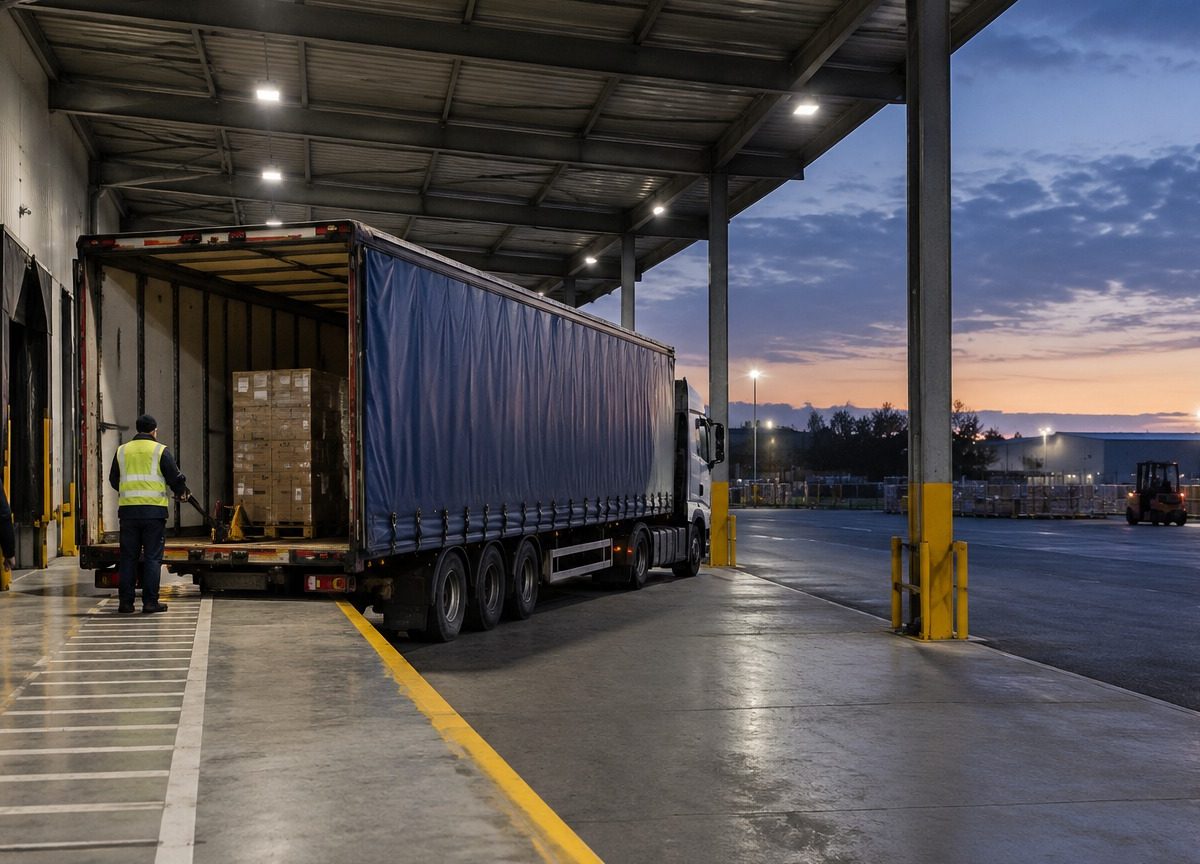
A loading bay combines vehicle movement, pedestrian crossings, changing daylight and close-range handling tasks. A weatherproof LED batten may be suitable for a covered working position, but selecting one from its IP rating alone overlooks the actual lighting and environmental demands.
For contractors and facility buyers, divide the project into zones before choosing fittings: the covered platform, the vehicle approach, pedestrian routes and any checking station. Each needs a defined lighting task, exposure assessment and installation arrangement. This guide concentrates on those loading-bay decisions rather than general warehouse aisle lighting.
Give different loading-bay tasks different lighting briefs
An operative reading a consignment label is doing a different visual task from a driver moving slowly through a yard. A single site-wide lux number can therefore be misleading. Record the task plane and the areas to which each target applies.
Thorlux’s loading-bay application guidance lists 150 lux maintained mean illuminance with minimum-to-average uniformity of 0.40 for loading bays. It separately lists 50 lux and 0.40 for pedestrian passages, vehicle turning, and loading or unloading points. These are the guide’s different application categories; they are not permission to choose the lower figure for every loading platform.
| Zone or task | Lighting value used in this brief | Basis and interpretation |
|---|---|---|
| Defined loading-bay working area | 150 lux; uniformity 0.40 | Reference category in the Thorlux guide |
| Defined transfer or turning area | 50 lux; uniformity 0.40 | Separate reference category; confirm the applicable task |
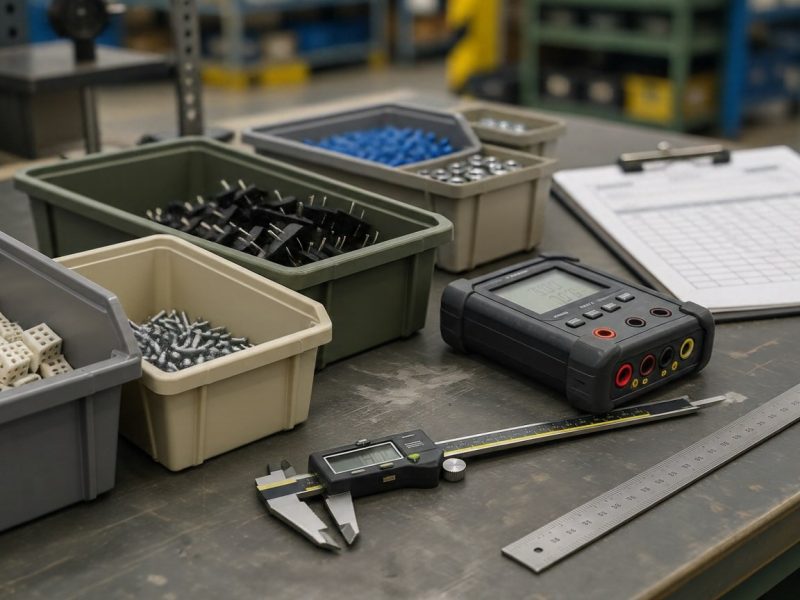
| Dedicated label-checking bench | 300 lux | Illustrative project target selected for the calculation brief |
| Nearby yard and pedestrian routes | Separately specified | Assess traffic, pedestrians, glare and local requirements |
The 300-lux bench value is an example, not a universal legal requirement. Confirm the destination’s applicable standards and the actual tasks. Neither a supplier table nor a preliminary lux calculation replaces the project’s agreed design criteria.
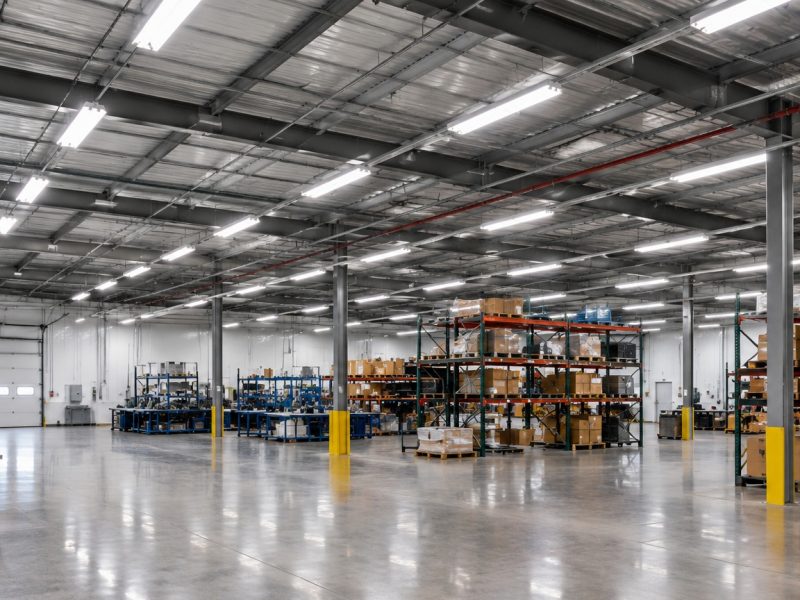
Truck bodies, raised doors and stored pallets can block light. Check representative conditions with vehicles present and absent. A calculation for an empty platform may miss the shadows that occur during the busiest part of the shift.
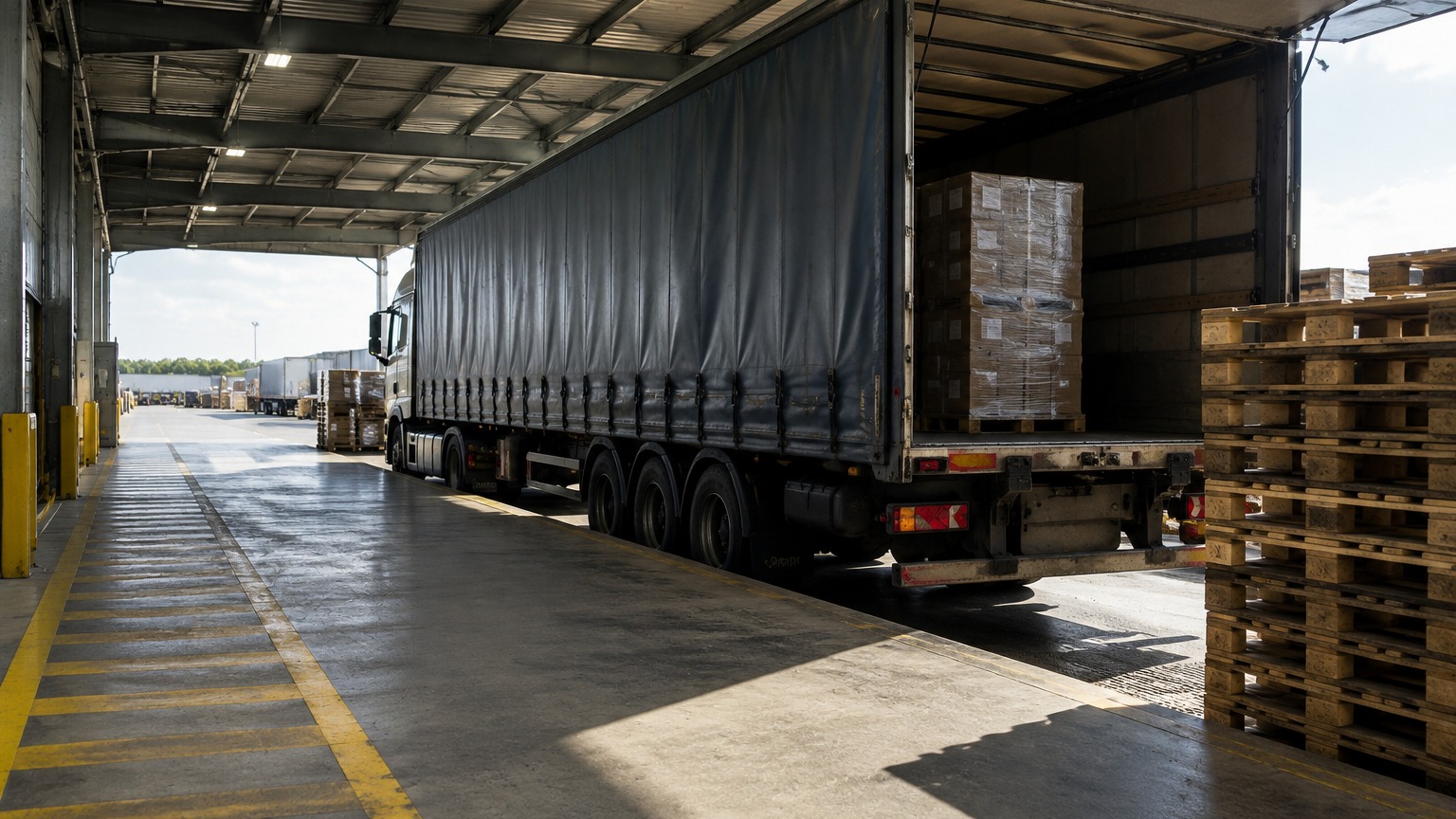
Distinguish canopy protection from the actual exposure
A roof does not make every position dry. Wind-driven rain can reach the canopy edge, vehicles bring water inside, and cold surfaces may experience condensation. Cleaning methods can introduce an entirely different exposure from ordinary weather.
Prepare a short environmental schedule. An example brief could specify −5°C to +35°C ambient conditions, wind-driven rain near the outer row, occasional freshwater cleaning and no direct hot high-pressure washing. These are assumed site conditions, not the operating limits of a selected product.
The enclosure’s materials, seals, entries and control accessories must suit that schedule. Coastal salt, chemical contamination and UV exposure need their own evidence. “Non-corrosive” and “weatherproof” are marketing descriptions unless the offered configuration and relevant conditions are identified.
Intertek’s ingress-protection explanation distinguishes protection against solids and water. IP65 and IP66 both use the dust-tight first numeral 6, while their water tests differ. An IP66 claim does not establish chemical resistance, UV stability or compatibility with every cleaning method.
For a high-pressure cleaning zone, do not promote a general IP66 fitting into a washdown solution by wording alone. Specify the cleaning pressure, temperature, distance and chemicals, then match the complete assembly to appropriate evidence. Our IP65 versus IP66 guide expands that comparison.
Calculate a starting quantity for one covered bay
Consider an illustrative 12 m × 6 m covered area, or 72 m², with a selected 150-lux maintained average target. Assume 4,320 delivered lumens per fitting, utilization factor 0.50 and maintenance factor 0.80.
Starting quantity = area × target lux ÷ (fixture lumens × utilization factor × maintenance factor).
This gives 72 × 150 ÷ (4,320 × 0.50 × 0.80) = 6.25, rounded up to 7 fittings for an initial proposal. It is a budget-level estimate, not an installation layout.
| Calculation condition | Average target | Utilization factor | Rounded starting quantity |
|---|---|---|---|
| Base illustrative canopy model | 150 lux | 0.50 | 7 |
| Less favourable light utilization | 150 lux | 0.40 | 8 |
| Whole-area higher-task comparison | 300 lux | 0.50 | 13 |
All rows assume the same 72 m², 4,320 lm and 0.80 maintenance factor. The final row illustrates the consequence of applying a higher average target across the whole area; it does not mean a small checking bench requires doubling all bay lighting.
Use actual photometry to check minimum illuminance, vertical visibility and shadows. If an area averages 150 lux, uniformity 0.40 requires at least 60 lux at the minimum point under that metric. A 30-lux minimum would give 0.20, even though the average remains 150.
Position fittings around the operation, not only the ceiling
Look along the driver’s approach, across the dock edge and toward the trailer opening. A bright source in the direct line of sight can make the operation uncomfortable without improving visibility of the obstacle or person that matters.
Separate canopy task lighting from large-yard lighting. A linear fitting selected for a sheltered low-level position is not automatically a replacement for a high-mounted yard luminaire. Review spill toward neighbours and avoid unnecessary upward light.
Document moving doors, loading equipment, sprinkler clearance and maintenance access on the installation drawing. Keep fittings and cables out of vehicle-impact paths. The exact mechanical protection and fixing arrangement must come from the project design and the manufacturer’s instructions.
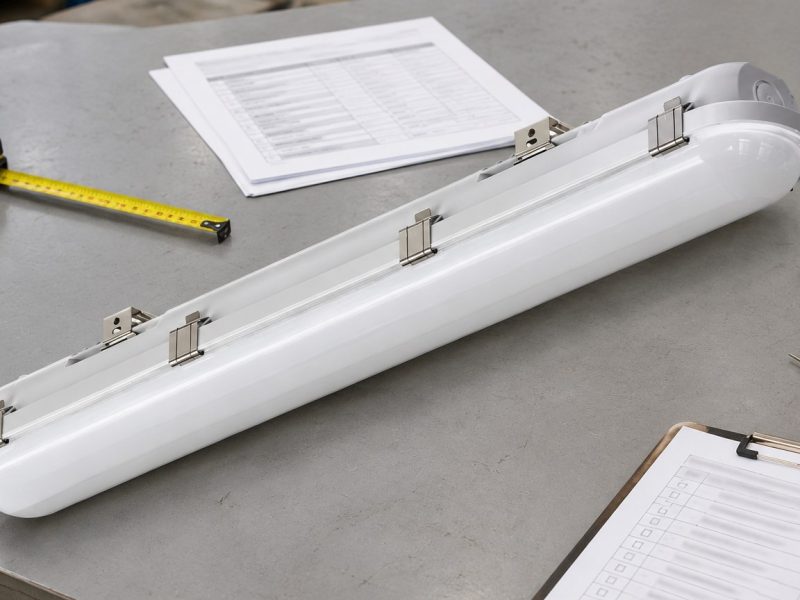
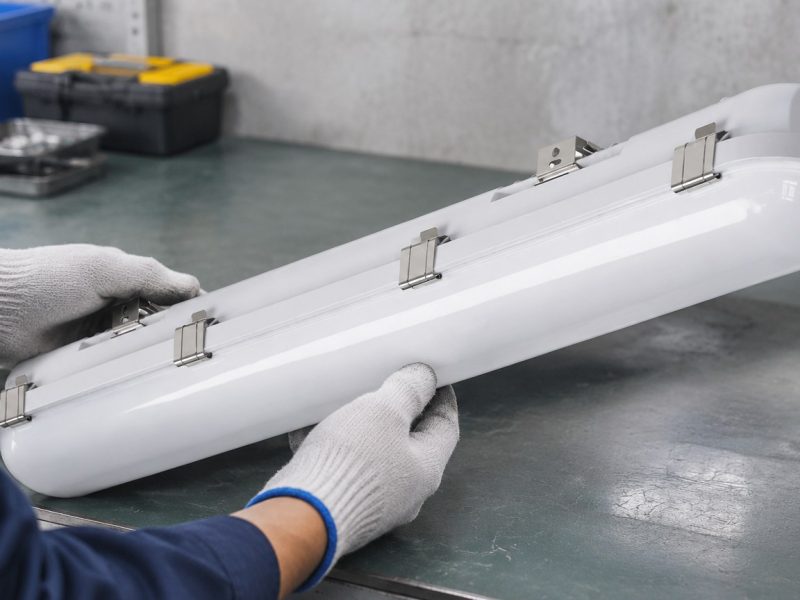
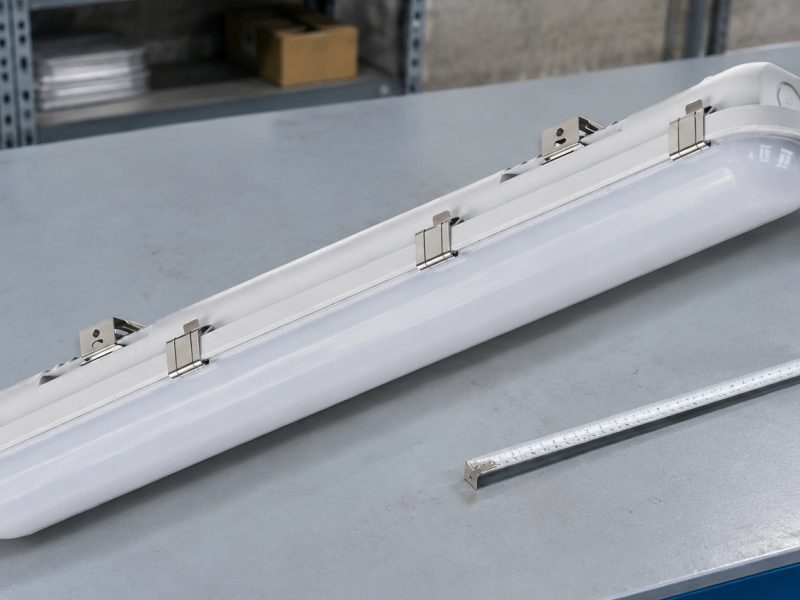
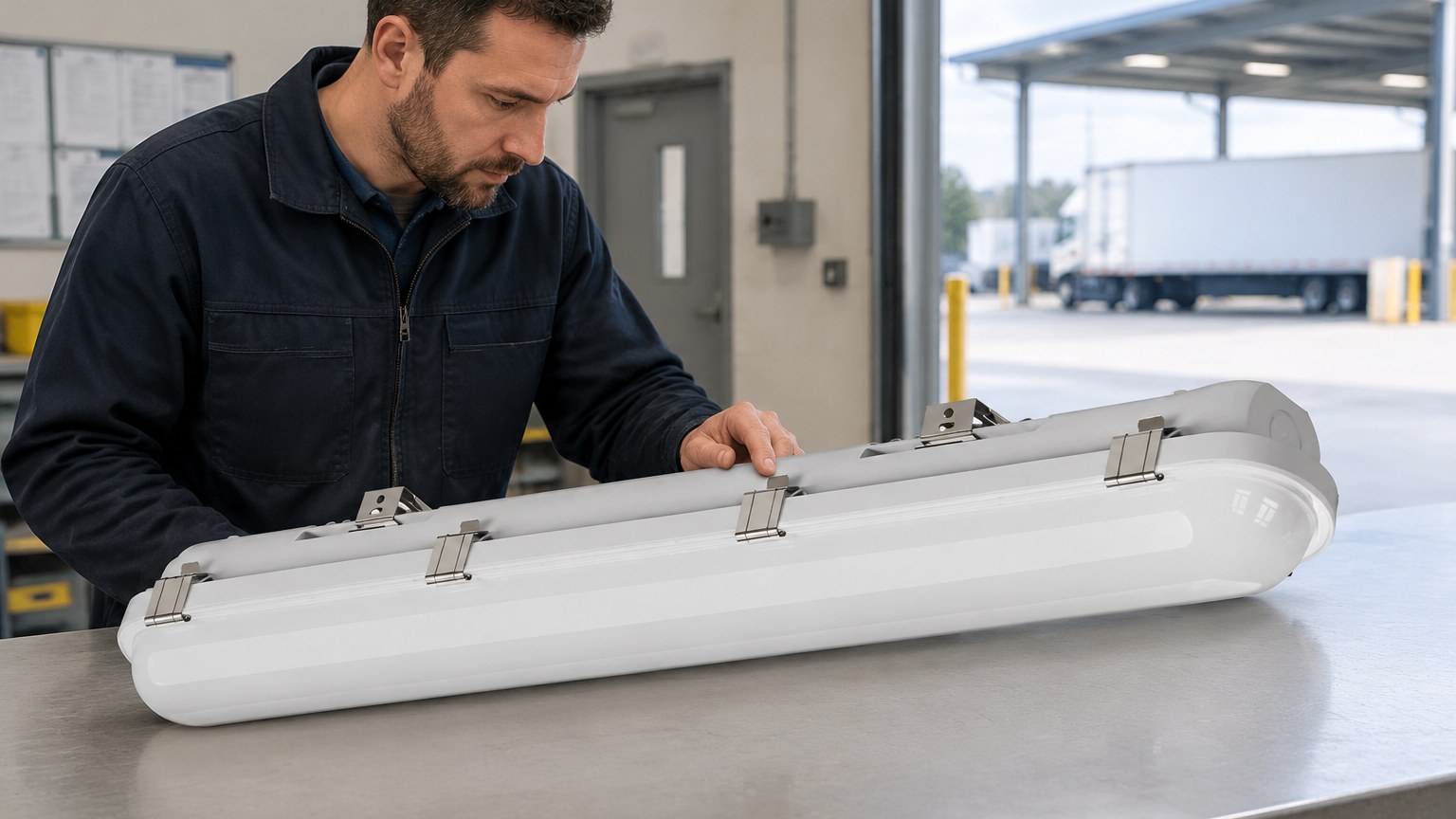
CoolShinePro’s documented 4ft 36W vapor-tight fitting can support a preliminary linear-product discussion: its record includes PC construction, IP66 and 200–240V AC at 50/60Hz. Those facts do not independently confirm exposed-canopy, coastal, UV or low-temperature suitability. The proposed position and conditions need to be matched to the offered version.
Model controls around safe working visibility
Daylight and occupancy can change the energy case, particularly when the canopy is occupied intermittently. The agreed control behaviour must still preserve safe visibility when workers or vehicles enter.
For a control example, six 36W fittings draw 216W. At 4,000 hours per year, continuous full-output operation uses 864 kWh. Assume a selected control arrangement actually operates half the time at full power and half at 25% electrical power. Equivalent full-power operation becomes 2,500 hours, and consumption is 540 kWh.
The illustrative saving is 324 kWh, or $48.60 per year at an assumed $0.15/kWh. The 25% power assumption is not a statement that a 25% dimming command produces that input. Use the selected driver’s measured dimming curve, include standby consumption and confirm acceptable light levels in each state.
During a sample test, check sensor coverage around doors, obstructions and the vehicle route. Confirm activation and return behaviour before extending the configuration to every bay.

Turn the bay survey into a complete quotation schedule
If the final design selects 8 fittings per bay across 4 bays, the working quantity is 32. Split that into the exact standard, controlled and separately specified emergency configurations. List which accessories, cable entries and mounting parts belong to each version.
For phased works, identify the release sequence: two bays first and two later, with 16 fittings in each release. Keep the configuration versions distinguishable in carton labels. Record each installed position, order code and document revision at handover so later repairs do not substitute a similar-looking but unapproved unit.
Ask the supplier to identify the actual body dimensions, input range, CCT, photometric file, environmental limits and maintenance method. Request evidence against the site brief rather than collecting unrelated certificates. Include the installation height, roof layout, vehicle positions and representative photographs.
For purchasing support, use our tri-proof supplier guide and bulk-quotation comparison. Send the zone schedule to CoolShinePro so that a proposal can address the actual covered-bay application, rather than merely quoting a weatherproof batten light by wattage.