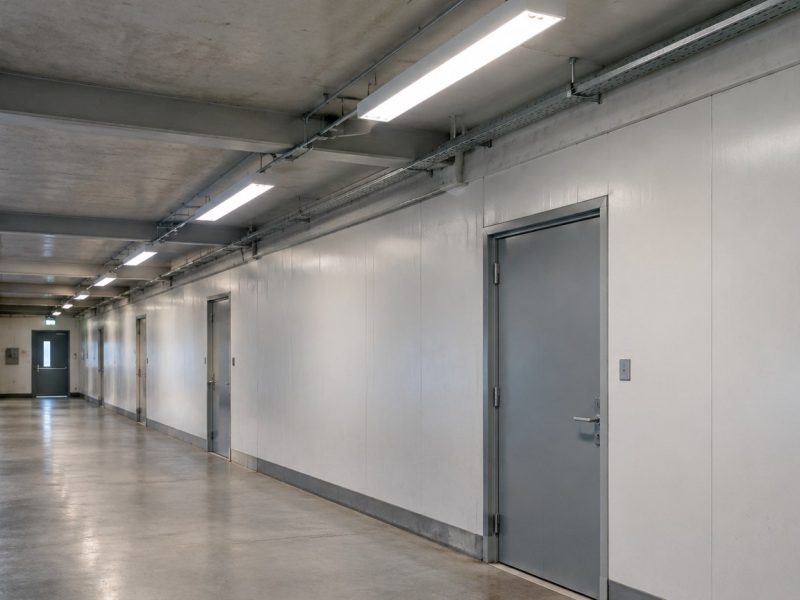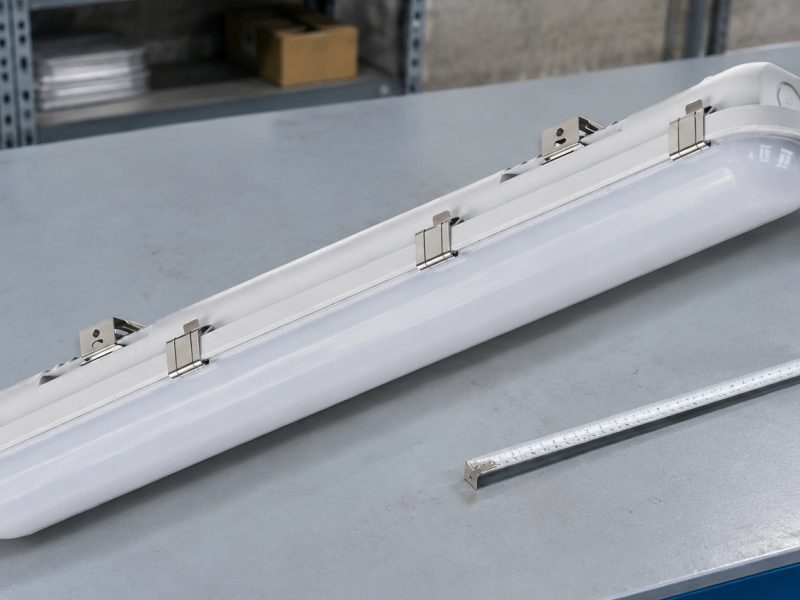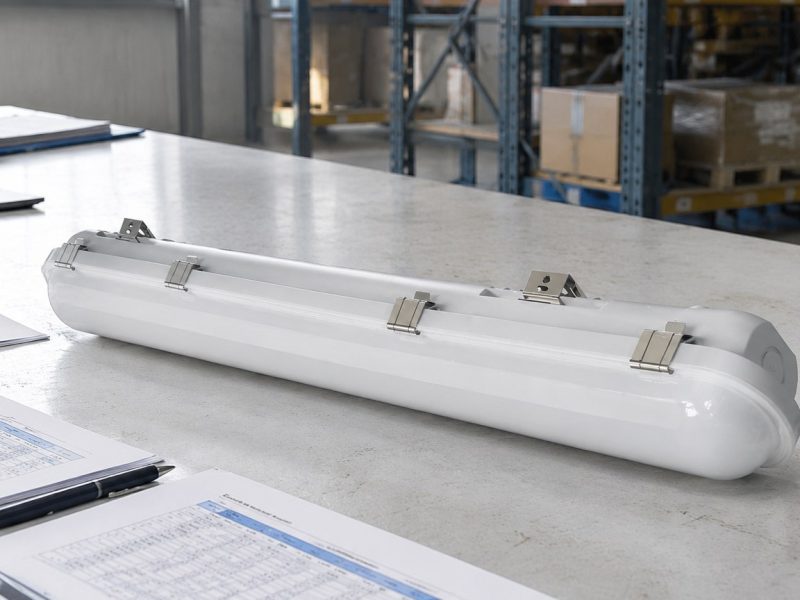
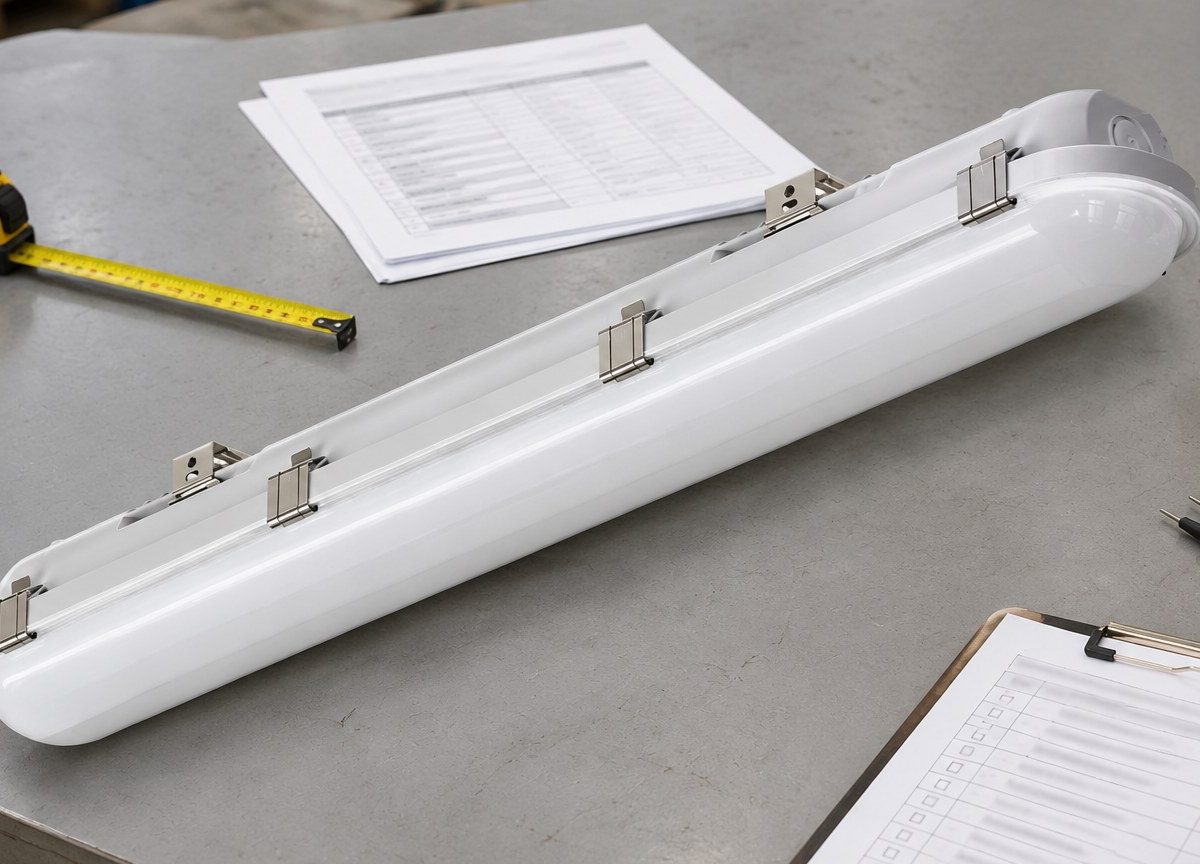
An integrated LED vapor-tight fitting and a T8 vapor tight fixture can both provide enclosed linear lighting, but they are different maintenance systems. The first combines an LED light engine and driver with a designed optical enclosure. The second uses replaceable tubular lamps, whose electrical arrangement must match the fitting.
For a contractor or distributor, the decision is therefore more specific than “which one is brighter?” Compare complete-system output, input power, lamp or driver replacement, sealing and spare-part support. This guide focuses on choosing the construction for a purchase order, rather than calculating an existing building’s retrofit payback.
Identify the four configurations buyers often mix together
“T8” describes a tubular lamp format, not a universal electrical specification. A fitting originally built for fluorescent tubes is not automatically an LED-ready enclosure, and an LED tube is not automatically suitable for every old ballast.
| Construction | Light source | Electrical arrangement | Main purchasing question |
|---|---|---|---|
| Integrated LED fitting | Dedicated LED board or module | Driver matched to the light engine | Which parts are serviceable, and are replacements available? |
| Fluorescent T8 fitting | For example, two nominal 36W tubes | Fluorescent ballast | What is the measured total input, including ballast? |
| LED-ready T8 enclosure | For example, two selected LED tubes | Wiring specified for those exact lamps | Which tube, supply arrangement and lamp holders are approved? |
| Converted existing fitting | Approved replacement lamps or kit | Depends on the conversion system | Is the host fitting suitable for that documented conversion? |
The wattages are examples of configurations, not interchangeable replacements. Fluorescent vapor tight fixtures may contain different ballasts, lamps and wiring even when their covers look alike.
In North American retrofit terminology, Type A LED tubes use a compatible fluorescent ballast; Type B uses a ballast-bypass arrangement; Type C uses an external LED driver. UL’s retrofit white paper explains these distinctions. The letters describe operating arrangements; they do not make a lamp suitable for every enclosed fitting or destination market.
Compare complete luminaire output, not two different lumen claims
A bare LED tube’s lumen rating and an enclosed fitting’s delivered lumens are different comparison points. The cover, reflector, internal geometry and operating temperature affect the final result. Ask for an assembled-luminaire photometric file for each proposal.
Here is an illustrative equal-output comparison, assuming 4,000 delivered lumens from each assembled fitting:
| Selected system | Assumed complete-fitting input | Delivered output assumption | Calculated system efficacy |
|---|---|---|---|
| Integrated LED proposal | 32W | 4,000 lm | 125 lm/W |
| LED-tube proposal | 40W | 4,000 lm | 100 lm/W |
| Existing fluorescent system | 80W | 4,000 lm | 50 lm/W |
These figures are a worked comparison, not universal performance ranges or CoolShinePro model ratings. If a supplier lists two 2,000-lumen tubes, you cannot enter 4,000 delivered lumens without accounting for the assembled enclosure. Likewise, the 80W example includes the assumed whole system, rather than treating two 36W lamp markings as the entire load.
The layout still determines whether that output is useful. Two fittings delivering 4,000 lumens can distribute light differently across an aisle or workbench. For a nominal 200-lux project target, compare both proposals in the same room model, with the same calculation plane and maintenance assumptions. The 200-lux target is a project example, not a rule for every workplace.
Use a real product as a reference without inventing a T8 counterpart
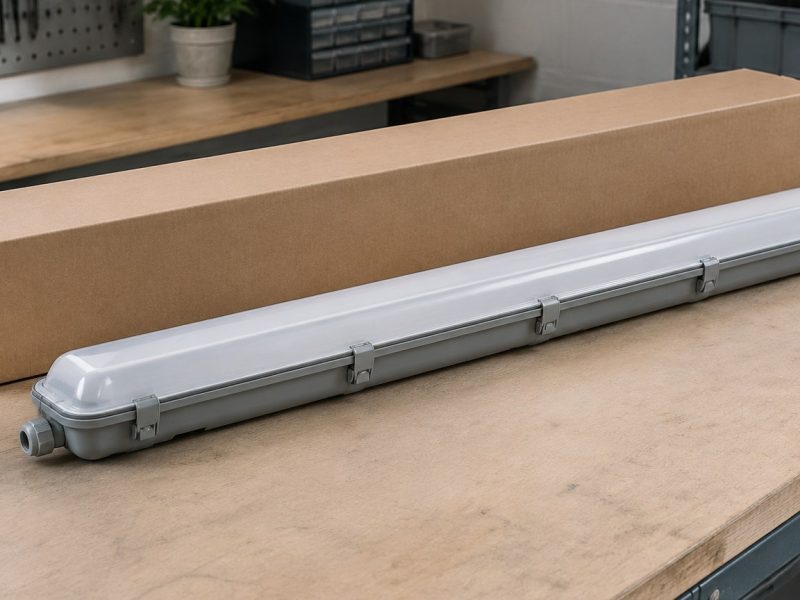
CoolShinePro’s 4ft 36W LED vapor-tight fitting documents a PC housing and diffuser, IP66, Ra 80, and 200–240V AC at 50/60Hz. Its available colour-temperature selections include 3000K, 4000K and 5000K. Confirm the ordered power and dimming version in the quotation.
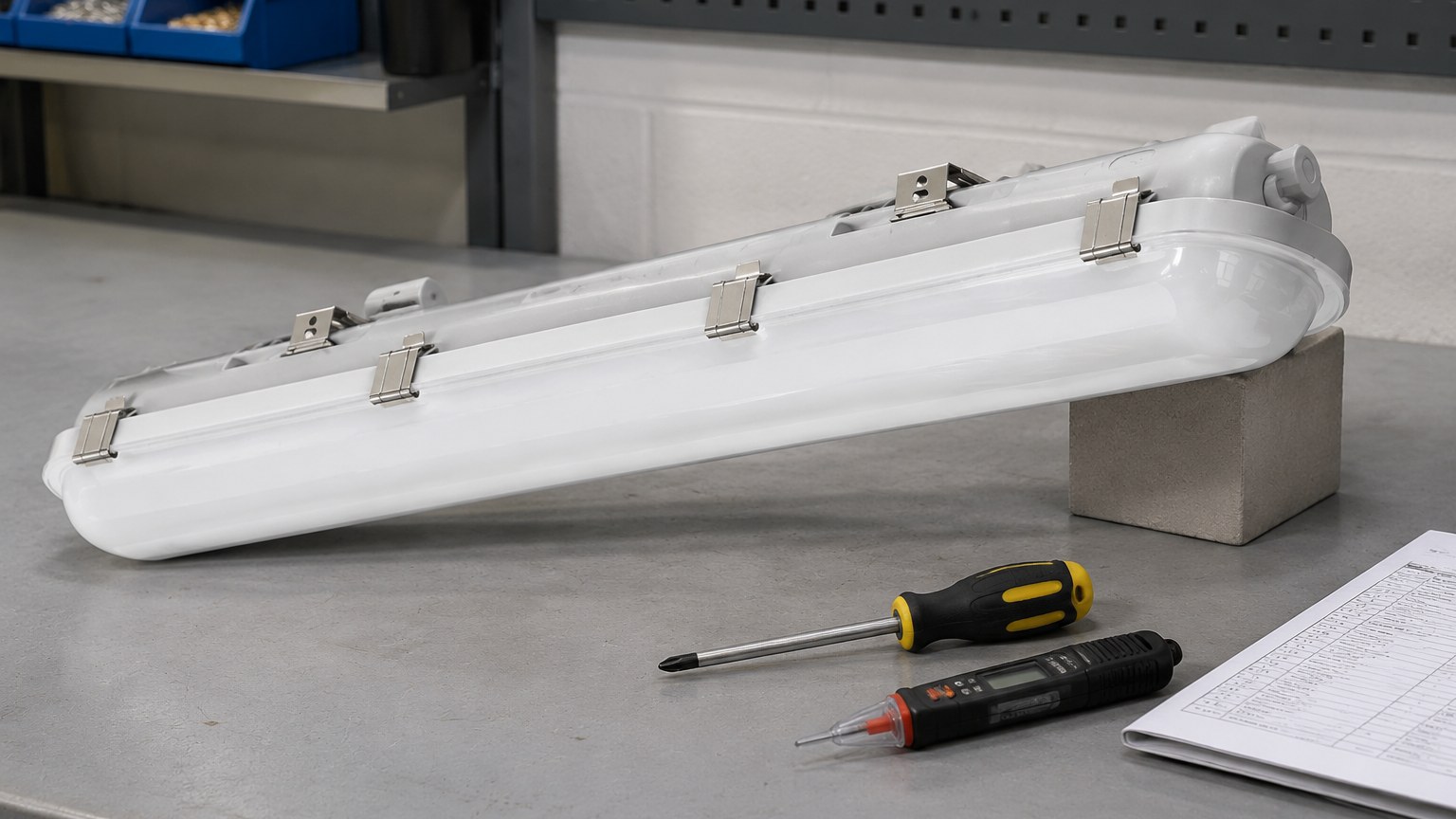
Its stated 120 lm/W × 36W gives a 4,320-lumen arithmetic reference. Confirm the ordered version’s measured output and photometry rather than treating that calculation as an independent report.
This product reference does not establish that a matching CoolShinePro T8 enclosure, 277V driver, emergency version or field-replaceable LED module is available. Those are separate configuration questions. A fair comparison uses two documented offers, not one real model and an imagined alternative.
Decide what your maintenance team will actually replace
Replaceable tubes can simplify inventory when the exact approved lamps are locally available and the enclosure remains serviceable. However, tube replacement also requires access, isolation, opening, resealing and functional checking. A long stockroom shelf of “similar T8 tubes” is not a compatibility plan.
Integrated does not necessarily mean disposable. Some fittings provide replaceable drivers or modules; others are supplied as complete-unit replacements. Confirm the manufacturer’s service instructions, access method and replacement order codes before purchase.
Consider a maintenance-planning example with 100 fittings over five years:
| Planning input | Tube-system example | Integrated-system example |
|---|---|---|
| Assumed service events | 20 lamp events | 5 complete-unit events |
| Assumed material per event | $8 | $35 |
| Assumed labour/access per event | $25 | $25 |
| Calculated service budget | $660 | $300 |
The event counts are deliberately stated assumptions, not failure-rate predictions. If the tube system needs only 5 events, its budget becomes $165. That reversal shows why service records and actual access costs matter more than a blanket claim that one construction always costs less to maintain.
For a project requiring a lift or shutdown, list those costs separately. A replaceable $8 lamp can still be expensive to reach. Conversely, an easily accessible enclosure with approved local spares can make a tube-based system practical.

Treat IP protection and cleaning as complete-assembly issues
An IP rating belongs to the tested enclosure arrangement. Opening it to change lamps or drivers means the gasket, clips, cable entries and cover must be correctly restored. A cracked cover or damaged gasket cannot be corrected by fitting a new lamp.
Intertek’s explanation of ingress testing distinguishes protection against solids and water. In IP66, the first 6 indicates dust-tight protection and the second indicates powerful-water-jet protection under the relevant test. It does not establish resistance to every cleaning chemical or hot high-pressure wash.
For 100 fittings, an illustrative 3% initial spare allowance means 3 spare fittings or equivalent approved replacement sets. Choose which to hold based on the maintenance plan; three complete integrated fittings and three spare tubes are not equivalent inventories. Include covers, seals and clips where the service instructions permit their replacement.
Make controls and emergency requirements explicit
“Dimmable” is incomplete without the interface, control range and compatible equipment. A 0–10V control circuit is not the same as a DALI installation. A tube fitting may use a dimming ballast, a separate driver or non-dimmable lamps; an integrated fitting also needs the correct driver version.
For a sample procurement split of 80 standard plus 20 controlled fittings, approve each version separately. Check start-up, dimming behaviour and the intended sensor or controller on an isolated sample circuit. Do not extrapolate a standard unit’s approval to every optional version.

Emergency lighting is a separate system requirement. A battery lamp or added battery pack does not by itself establish that the complete arrangement meets the project’s emergency criteria. Specify duration, emergency output, test method and destination requirements in a separate schedule.
Choose the structure around the purchase objective
For a new installation, an integrated proposal can make sense when its documented photometry, input and service plan match the project. For a standardized replacement-lamp estate, a documented T8 system can make sense when compatible spares and sound enclosures support the maintenance strategy.
For an ageing installation, first inspect the enclosure population. Broken clips, brittle covers, corroded internals and missing labels can shift the decision toward new fittings. Our 4ft bulk-buying guide helps define that purchase scope.
Send CoolShinePro the destination, supply, room layout, target lighting result, quantities and service requirements. Ask for the exact assembly and its matching documentation. Use the supplier assessment guide to compare support, and contact us for a configuration-specific proposal.