
Evaluate tri-proof light suppliers on verifiable specifications, factory capacity, test documentation scope, and commercial terms. Match the fixture’s IP rating, housing construction, and electrical parameters to your installation environment. Confirm minimum order quantity, production lead time, customization scope, and warranty before placing an order. Compare suppliers using one written specification to identify technical gaps and unresolved compliance questions.

Introduction: Why Choosing the Right Tri-Proof Light Supplier Matters
Selecting a tri-proof light supplier requires more than unit price comparison. Importers, distributors, lighting brands, and project purchasers need fixtures that match the installation environment and suppliers who can document specifications and meet delivery commitments. The terms *tri-proof light fixture*, *tri-proof light*, and *tri-proof lamp* appear in commercial lighting descriptions but do not establish a specific protection rating.
What to Evaluate Before Selecting a Supplier
Four areas determine supplier suitability:
- Product match: Environmental protection needs, electrical input, light output, and mounting.
- Technical evidence: Documentation applying to the exact quoted model.
- Manufacturing capability: Factory identity, production arrangements, and available capacity.
- Commercial conditions: MOQ, lead time, customization scope, warranty, and shipping terms.
Define Your Application and Technical Requirements
Document installation site conditions before requesting quotations. Identify exposure to water jets, dust accumulation, cleaning chemicals, corrosive substances, temperature range, and mounting constraints. Use these requirements to create one specification that every shortlisted supplier must address.
Identify Environmental Conditions
Describe the installation environment rather than selecting by product name. Consider indoor or outdoor placement, direct water exposure during cleaning, and chemicals that could affect housing or seals. An IP rating describes protection against solid objects and water ingress under specified test conditions. It does not independently establish chemical resistance, impact resistance, or hazardous location suitability.
IP65 provides dust-tight protection (first digit 6) and protection against water jets from a 6.3 mm nozzle at 12.5 liters per minute (second digit 5). IP66 offers the same dust protection but withstands more powerful water jets. Neither rating establishes immersion protection or explosion-proof certification.
Build a Model-Specific Specification Checklist
Request the following for each quoted fixture:
| Parameter | What to request | Why it matters |
|---|---|---|
| Ingress protection | IP rating with applicable test report showing tested model | Assess suitability for dust and water exposure. |
| Electrical input | Rated voltage, frequency, power factor | Establish compatibility with installation supply. |
| Power and light output | Rated wattage, total lumen output, efficacy (lm/W) | Compare power consumption and delivered illumination. |
| Light quality | CCT in Kelvin, CRI value | Match fixture to project lighting requirements. |
| Housing and sealing | Housing material, seal material, corrosion-resistance evidence | Evaluate for moisture and chemical exposure. |
| Installation | Dimensions, weight, mounting method, wiring entry | Identify installation constraints. |
| Operating environment | Rated ambient temperature range | Compare with actual site conditions. |
| Warranty | Warranty duration, coverage, exclusions, claim procedure | Support maintenance and replacement planning. |
Select protection level and construction using documented project conditions, not product name alone.
Verify Supplier Identity, Factory Capabilities, and Production Capacity
A tri-proof light factory should identify its manufacturing location, explain production arrangements, and provide capacity information relevant to your order. Distinguish total factory output from capacity available for a specific product and schedule.
Distinguish a Manufacturer from a Trading Company
Request the legal company name, manufacturing address, and which production processes are performed in-house versus by subcontractors. Ask how incoming components, assembly, final inspection, and nonconforming products are handled. Establish which entity will be responsible for product specifications and contractual commitments.
Assess Capacity Against Your Order
CoolShinePro’s company information states:
- Location: Guzhen, Guangdong, China
- Established: 2014
- Factory area: 10,000 m²
- Total factory capacity: 80,000 units per month
These are company-provided figures, not independently verified production records. For bulk orders, confirm capacity available for the selected fixture, planned production schedule, and constraints from customization or component availability.
Evaluate Product Quality and Request Relevant Test Reports
Assess fixtures through technical documents, test reports, sample inspection, and quality-control procedures. Match every report to the exact quoted model and configuration rather than accepting general product range descriptions.
Match Test Evidence to the Exact Model
Request documentation identifying the tested model, test scope, test date, and issuing laboratory. Check whether the report covers the housing, sealing arrangement, and configuration of the offered fixture. During sample inspection, examine housing joints, seals, cable-entry points, fasteners, and electrical connections. Record visible differences between the sample and written specification.
For corrosive environments, request evidence relevant to the actual chemicals and exposure conditions. A general description such as *corrosion-resistant light fixture* does not establish compatibility with specific substances.
Check Construction and Quality-Control Records
Ask how the factory controls material and component changes. Confirm whether substitutions require approval and how production units are checked against the approved sample. Sample inspection assesses visible construction and workmanship but does not replace laboratory testing or establish long-term durability.
Check Applicable Standards and Verify Certification Documents
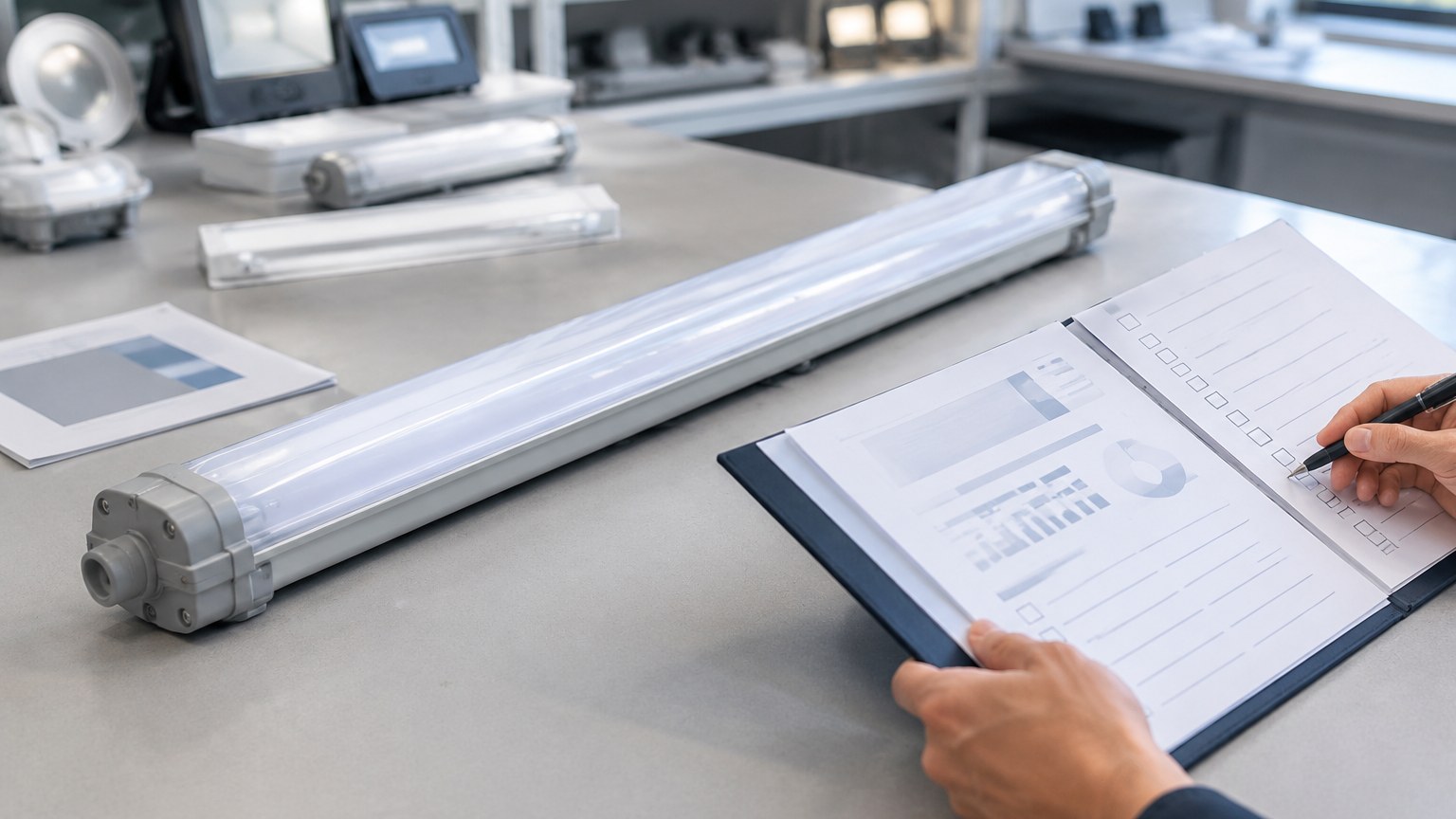
Certification requirements depend on the destination market, product configuration, and application. Identify applicable legal and project requirements, then obtain documents covering the exact model. A certificate should not be assumed to apply to every fixture in a supplier’s range.
Identify Requirements for the Destination Market
Ask the importer, project consultant, or compliance specialist to identify relevant requirements for the intended market. Request applicable certificates, declarations, and test reports. Where verification services are available, check the issuing organization, document scope, certificate holder, and validity. Changes to electrical components, housing, or other features may affect existing documentation scope. Confirm status of any modified configuration before approving production.
Compare Quotations Beyond the Unit Price
Compare quotations using the same model requirements, order quantity, packaging scope, documentation requirements, and delivery terms. Record exclusions separately and calculate full procurement cost rather than comparing headline prices.
Standardize the Quotation Scope
Use a like-for-like numerical comparison before comparing price. In this worked example, both proposals are assumed to deliver 5,000 lm and operate for 12 hours per day, 365 days per year. The figures illustrate the calculation; they are not actual supplier quotations.
| Comparison dimension | Proposal A | Proposal B | Decision value |
|---|---|---|---|
| Input power | 40 W | 36 W | B uses 4 W less at the assumed equal light output |
| Luminaire output | 5,000 lm | 5,000 lm | Keep delivered light on the same comparison basis |
| Efficacy: output ÷ power | 125 lm/W | About 138.9 lm/W | Compare complete-luminaire values, not LED-chip claims |
| Annual operating time | 4,380 h | 4,380 h | Same 12 h/day schedule for both options |
| Annual electricity per fixture | 175.2 kWh | 157.68 kWh | Difference: 17.52 kWh per fixture |
| Annual electricity for 100 fixtures | 17,520 kWh | 15,768 kWh | Difference: 1,752 kWh; apply the actual tariff |
Compare quoted unit price, documentation scope, warranty and confirmed delivery milestones separately; an unpriced example is not a real commercial offer.
Calculate the Total Procurement Cost
Request itemized quotation covering product price, customization or tooling charges, packaging, freight, and other costs. Confirm currency, payment milestones, quotation validity, shipment terms, and responsibility for transport and import charges. If suppliers quote different specifications, resolve differences before treating prices as comparable.
Compare Energy Consumption in Multi-Fixture Projects
For projects requiring multiple fixtures, calculate annual energy consumption differences. In a hypothetical comparison: a 40 W fixture operating 12 hours daily consumes 175.2 kWh per year (40 W × 12 h/day × 365 days / 1000). A 36 W fixture under the same schedule consumes 157.68 kWh per year, a difference of 17.52 kWh (10%) per fixture. For 100 fixtures, the annual saving would be 1,752 kWh. At an illustrative tariff of $0.15 per kWh, this represents $262.80 per year, excluding controls, maintenance, or tariff variations. Actual savings depend on real operating hours, local electricity costs, and fixture efficiency.
Confirm MOQ, Sample Lead Time, Bulk Delivery, and Customization Terms
Obtain written confirmation of MOQ, sample availability, production lead time, customization scope, and shipping arrangements. Establish whether the approved sample represents final production configuration and document conditions that could change price or schedule.
Verify the Sample-to-Bulk Process
CoolShinePro states small samples can be delivered in approximately 10 days and bulk orders in approximately 15 days. The stated bulk MOQ is 500 units and may be negotiable. Confirm timing basis, selected model, order conditions, and shipping arrangements before relying on these figures. Production lead time and total delivery time represent different stages of the purchasing process.
Document Customization Requirements
CoolShinePro states all products support customization. Include relevant requirements in the purchase specification: dimensions, electrical input, CCT, labeling, packaging, and other agreed changes. Ask whether modifications affect pricing, production timing, or applicable documentation. Approve the final specification and sample before authorizing bulk production.
Evaluate Communication, Warranty Terms, and After-Sales Support
Document supplier communication and after-sales procedures before placing an order. Obtain written answers to technical questions, clear responsibility for product conformity, and defined procedures for handling defects or warranty claims.
Assess Technical Responsiveness
Check whether the supplier provides consistent answers supported by product documents. Record unresolved questions and assign responsibility for closing them before purchase approval.
Clarify Warranty and Claims Handling
Request warranty duration, coverage, exclusions, claim deadlines, evidence requirements, and available remedies in writing. Confirm how defects are reported, investigated, and resolved, including responsibility for replacement shipping.
Use a Supplier Evaluation Checklist to Compare Candidates
A structured checklist provides consistent supplier screening. Separate mandatory technical and compliance requirements from commercial preferences, and retain supporting evidence for each decision.
| Step | What to check | Evidence or action | Decision |
|---|---|---|---|
| 1. Define requirements | Environment, electrical input, lighting, installation | Approved project specification | Resolve essential requirements first. |
| 2. Screen supplier | Identity, manufacturing arrangements, capacity | Company information and production records | Clarify unexplained gaps. |
| 3. Review model | Specifications and performance claims | Datasheet, reports, sample | Identify unsupported requirements. |
| 4. Verify compliance | Applicable rules and document scope | Relevant certificates and reports | Resolve compliance gaps. |
| 5. Compare offers | Equivalent scope, price, MOQ, delivery | Itemized quotations | Assess total cost and feasibility. |
| 6. Approve order | Sample, customization, warranty, acceptance criteria | Written specification and purchase terms | Proceed after critical issues resolved. |
Record each item as verified, pending, or not applicable, with document reference or responsible person. Assess document relevance to the product and project, not quantity supplied.
Common Sourcing Mistakes to Avoid
Main risks include selecting fixtures by name alone, accepting protection claims without applicable evidence, comparing different specifications, and treating estimated delivery dates as guaranteed commitments. Written requirements prevent misunderstandings between quotation, sample approval, and bulk production.
Avoid Unsupported Performance Claims
Do not assume a vapor-tight light and every tri-proof fixture have identical specifications. An IP rating does not independently establish chemical resistance, operating-temperature limits, or hazardous location suitability.
Prevent Specification and Delivery Disputes
Before issuing a purchase order, confirm the exact model and approved technical specification. Check that supporting reports apply to the quoted configuration. Document any component substitutions or design modifications. Confirm production timing, shipping arrangements, and order conditions. Define acceptance criteria and remedies for nonconforming goods in writing.
Conclusion: Choose a Supplier Based on Evidence and Project Fit
Selecting a tri-proof lighting fixture supplier requires documented assessment of technical suitability, manufacturing arrangements, product evidence, commercial conditions, and delivery feasibility. A consistent evaluation process identifies unresolved issues before committing to bulk orders. CoolShinePro can be included in sourcing evaluation using its supplied company information and stated commercial terms, subject to confirmation for the selected model and order.
Prepare a Complete Request for Quotation
When requesting quotations, provide installation environment, destination market, required specifications, estimated quantity, target delivery date, and customization needs. Ask for the corresponding datasheet, applicable test documentation, and written commercial conditions.
Frequently Asked Questions
What is a tri-proof lighting fixture used for?
A tri-proof lighting fixture is marketed for environments requiring protection against dust, water, and potentially other environmental exposure. Suitability depends on the exact model, ingress protection rating, construction, installation conditions, and supporting documentation. The product name does not establish performance.
How do I verify the IP rating of a tri-proof light?
Request a test report identifying the tested model, test scope, and issuing laboratory. Compare the tested configuration with the quoted fixture, including housing and sealing components. IP65 testing for water protection (IPX5) uses a 6.3 mm nozzle at 12.5 liters per minute from 2.5–3 meters distance for at least 3 minutes. A product listing or printed label alone does not establish independent verification.
What is the difference between a tri-proof light and a vapor-tight light?
The terms overlap in commercial descriptions but do not guarantee identical specifications. Vapor-tight commonly describes an enclosure intended to limit moisture and contaminant ingress, while tri-proof is a broader product description. Compare the actual IP rating, construction, test evidence, and intended installation conditions for each model.
What documents should I request from a tri-proof light supplier?
Request model-specific datasheet, relevant test reports, applicable certificates or declarations, installation instructions, warranty terms, and written commercial conditions. Check issuing organization and document scope. Required documents depend on destination market, project specification, and product configuration.
How can I compare tri-proof light factories beyond price?
Compare manufacturing arrangements, product documentation, sample consistency, customization scope, MOQ, production lead time, warranty conditions, and total procurement cost. Request equivalent quotations based on one written specification. If a supplier cannot demonstrate a mandatory technical or compliance requirement, record the gap before considering its offer equivalent.
What should I confirm before placing a bulk order for tri-proof lights?
Confirm final model, approved specification and sample, order quantity, unit price, applicable documents, customization details, packaging, production schedule, shipping terms, payment conditions, and warranty responsibilities. Record acceptance criteria and procedures for nonconforming goods in writing. Review any proposed product modifications before authorizing bulk production.