A waterproof dustproof corrosion proof light is often requested as one description. In procurement, the words represent different questions. Ingress concerns the assembled enclosure; chemical compatibility concerns the actual materials, substances and exposure conditions. One protection label cannot answer both.
Describe what reaches the fitting, at what concentration and temperature, and for how long. An exposure schedule produces a more useful quotation than asking for the strongest tri-proof light.
Separate ingress from chemical compatibility
An IP rating describes classified ingress protection under specified test conditions. It is not a chemical-resistance grade, salt-corrosion certificate or permission to use every cleaning method. Compare it separately using our IP65 versus IP66 guide.
TRILUX identifies acids, alkaline substances, gases, salt fog, humidity, UV exposure and cleaning methods among conditions that affect selection. Its surrounding-conditions guidance also discusses material compatibility. Evaluate the complete exposure rather than infer suitability from plastic housing alone.
Build a numerical exposure brief
Record the cleaning product, diluted concentration, solution temperature, contact duration, frequency and rinse method. These hypothetical procurement examples are not approved cleaning recipes or material limits.

| Exposure example | Numerical information supplied | Evidence needed for the offered assembly |
|---|---|---|
| Covered dry storage | 20–30°C ambient; inspection every 30 days | Appropriate enclosure and maintenance instructions |
| Packing room cleaning | Identified detergent at 1%; 25°C; 10 minutes once daily | Compatibility of housing, diffuser, gasket and clips under those conditions |
| Intensive cleaning zone | Identified detergent at 2%; 45°C; 15 minutes twice daily | Separate compatibility assessment, including cleaning method and cumulative effects |
| Coastal utility area | Identified salt exposure and 24-hour operating pattern | Configuration-specific corrosion evidence; IP is insufficient |
A 2% concentration is twice 1%, but does not imply twice the damage or half the life. Material response depends on the chemical, stress and temperature. Do not interpolate a resistance limit from concentration alone.
Compare all components
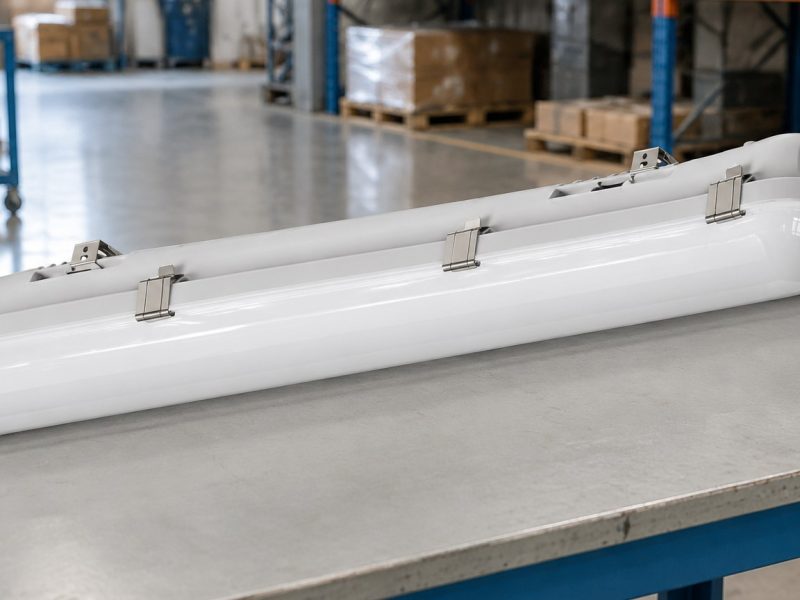
Ask for diffuser material, end caps, gasket, clips and cable-entry components. A compatible diffuser does not resolve an unsuitable seal. A corrosion-resistant clip does not protect a polymer against an incompatible substance.
Evaluate polycarbonate and PMMA against the actual exposure rather than label either universally superior. Metal parts also need a specified grade and finish; stainless without further detail is an incomplete description.
Changing six clips per fitting across 200 fittings affects 1,200 clips. Approve the material and closure specification before production. Alternative clips may also alter fit and closure pressure.
Quantify cleaning frequency
A hypothetical twice-daily regime produces 730 cleaning events over 365 operating days. At 15 minutes per event, summed contact time is 182.5 hours annually. Once-daily cleaning for 10 minutes totals approximately 60.8 hours. These describe exposure records, not predicted life or equivalent continuous immersion tests.
Ask whether supporting evidence addresses intermittent contact, relevant temperature, rinsing and mechanical stress. A test on raw material can be useful without proving the entire assembled luminaire. Document the parts and test conditions to which the result applies.
For practical wet-area purchasing, our car-wash lighting guide separates site conditions from the lighting calculation.
Review the actual sample
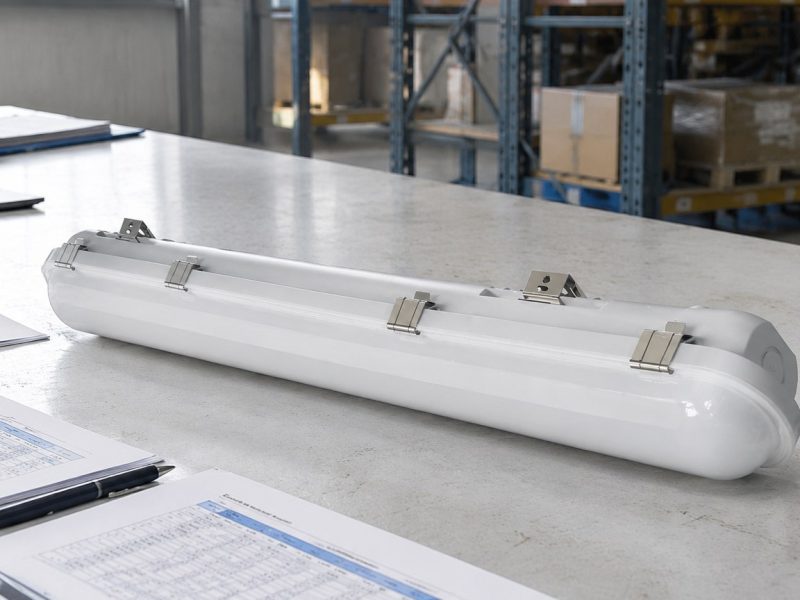
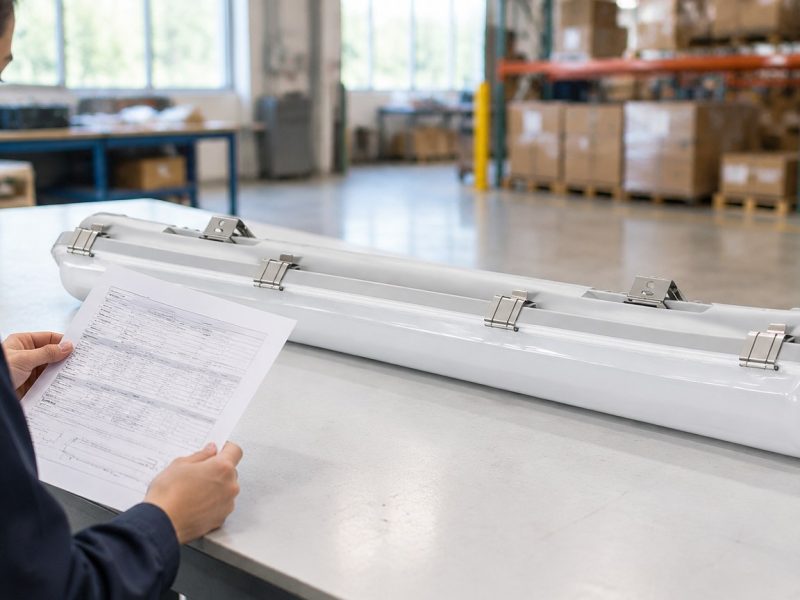
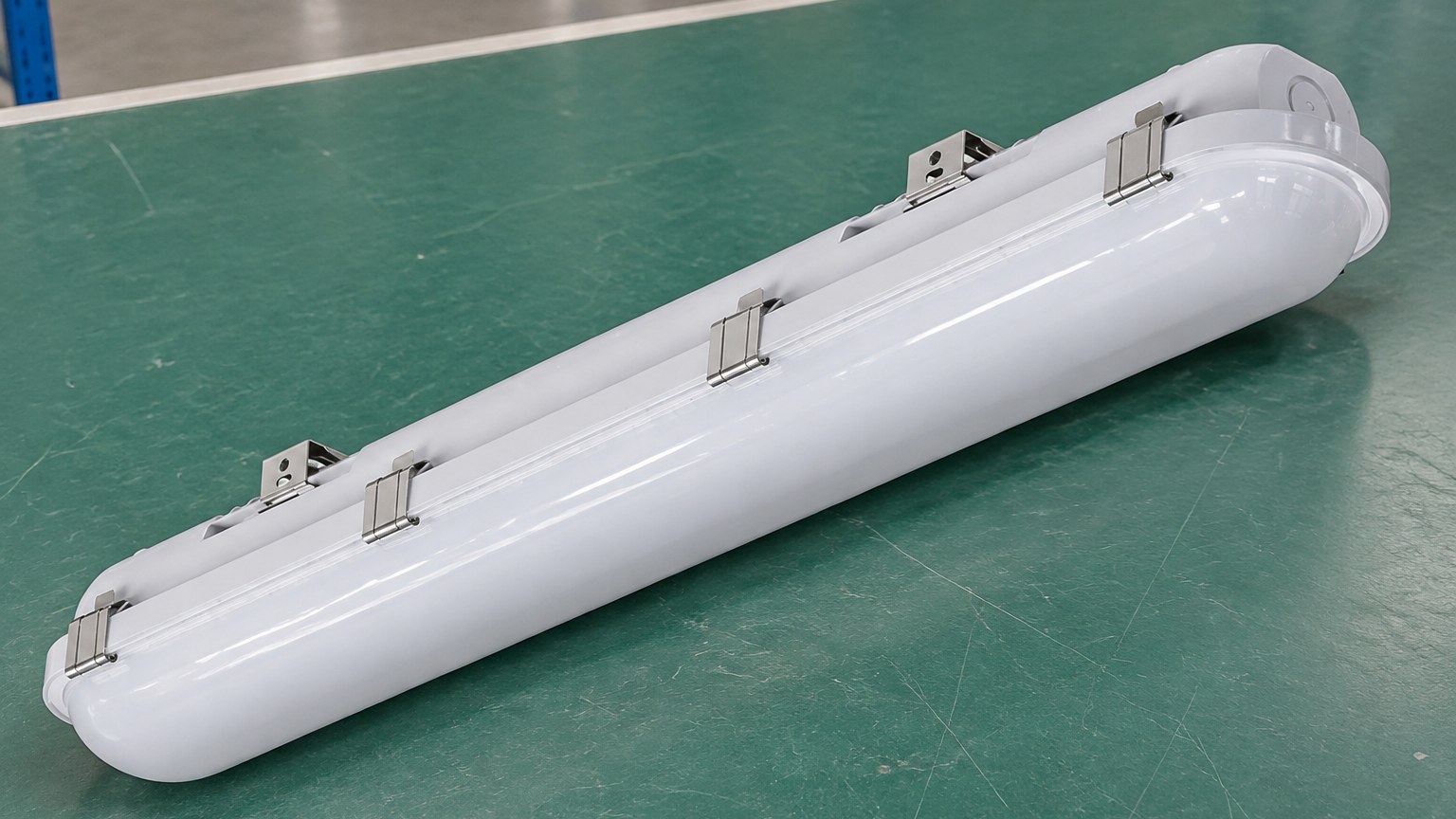
CoolShinePro’s documented 4ft fixture has a PC housing. This does not establish compatibility with the substances in the example table. Submit the intended exposure when requesting the appropriate configuration.
With the sample safely isolated, review closure consistency, visible gasket seating and cleaning access. Any compatibility test needs an agreed procedure and competent personnel; do not improvise chemical or electrical tests at a purchasing desk.
Keep baseline photographs and the exact sample revision. A later polymer, gasket or clip substitution must be reviewed against the approved exposure schedule, even when the product-family name remains unchanged.
Include maintenance in the price comparison
Assume a lower-price option saves $4 per fitting across 150 fittings: $600 initially. If a later component repair costs $12 in materials and $18 in labour per position, repairing 20 positions also costs $600, before access and downtime. This is a sensitivity example, not a prediction of failures.
Compare component specifications, access costs, spares and permitted cleaning methods. Our bulk quotation guide explains how to keep these visible in the offer.
Approve the exposure and assembly together
Submit quantity, voltage, installation position, lighting requirement, maintenance access and exposure schedule. Identify the conditions requiring documented compatibility before approval. Keep wet-area lighting separate from hazardous-area classification: chemical exposure alone does not define an explosion-protection requirement.
Approve a traceable complete assembly and maintenance method. This gives the purchase order concrete conditions and component requirements instead of an unrestricted corrosion-proof promise.