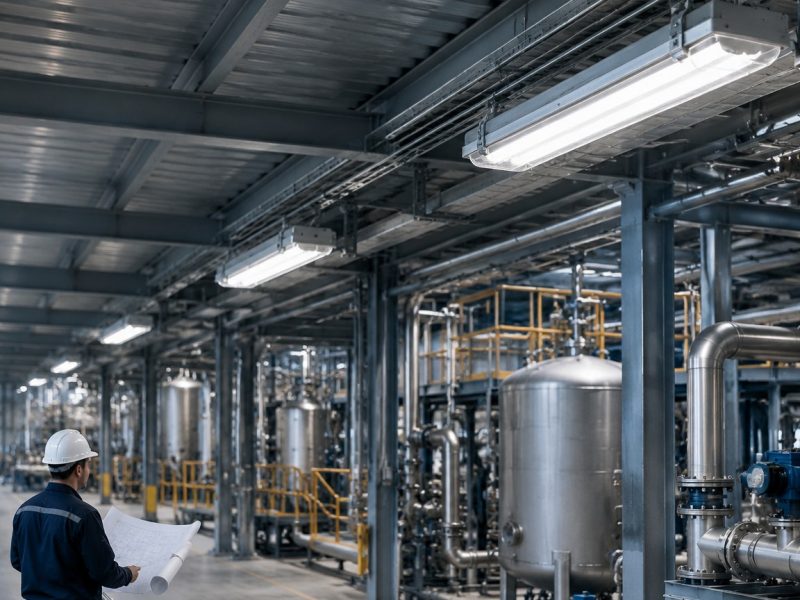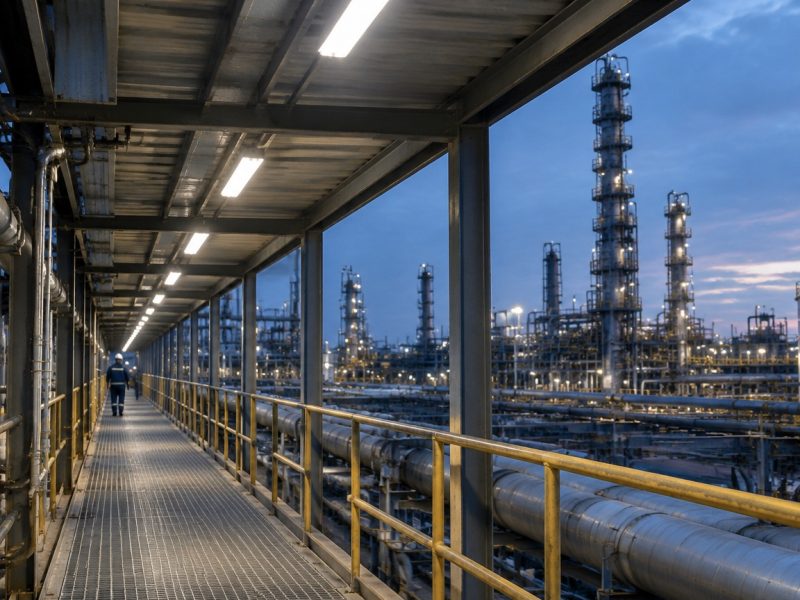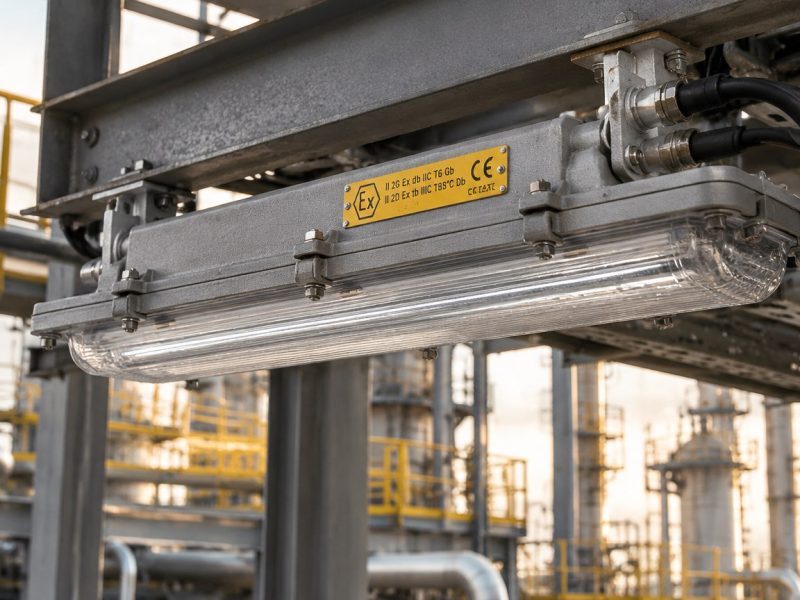
A warehouse vapor tight light should help workers identify stock, read labels and move safely between racks. A bright floor is only part of that job. The purchasing brief must also describe rack-face visibility, picking positions, obstructions and the conditions around loading doors. For an importer or project buyer, those details determine which sealed linear fixtures belong in the quotation.
Start with a drawing showing aisle widths, rack heights, mounting positions and the work performed in each zone. Then separate general storage, active picking and packing benches instead of buying one wattage for the whole building. This guide turns that approach into numerical comparisons and a configuration-based enquiry.
Put horizontal and vertical lighting on separate lines
Horizontal illuminance describes light on a floor or bench. Vertical illuminance describes light reaching a rack face or label. Increasing the total lumens above an aisle does not automatically improve a shadowed label several shelves down.
As a UK-oriented reference, Ansell’s warehouse lighting guidance distinguishes 100 lux in open storage from 200 lux where it is continuously occupied. It also discusses 150 lux on the floor of manned rack gangways and 200 lux on rack faces, with uniformity of 0.40. These reference conditions should be matched to the project’s applicable design criteria.
| Warehouse task | Numerical reference for the brief | Measurement or procurement consequence |
|---|---|---|
| General open storage | 100 lux in the cited guidance | Identify the horizontal measurement plane |
| Continuously occupied open storage | 200 lux in the cited guidance | Separate it from occasional-access storage |
| Manned rack gangway | 150 lux at floor level in the cited guidance | Include rack and vehicle obstructions in the model |
| Reading rack-face identification | 200 lux vertically in the cited guidance | Calculate the actual label and picking positions |
| Uniformity check | Minimum/average = 0.40 in the cited rack guidance | A 200-lux average implies an 80-lux minimum at that ratio |
| Detailed packing bench | Example project target: 300 lux on a 0.8 m-high bench | A separately selected planning input, not a universal warehouse requirement |
For example, an aisle averaging 200 lux with a darkest measured point of 40 lux has a minimum-to-average ratio of 0.20. The same average with an 80-lux minimum gives 0.40. Reporting only the average hides that difference. The measurement grid and task plane must remain consistent when comparing designs.
Choose the fixture around the installation envelope
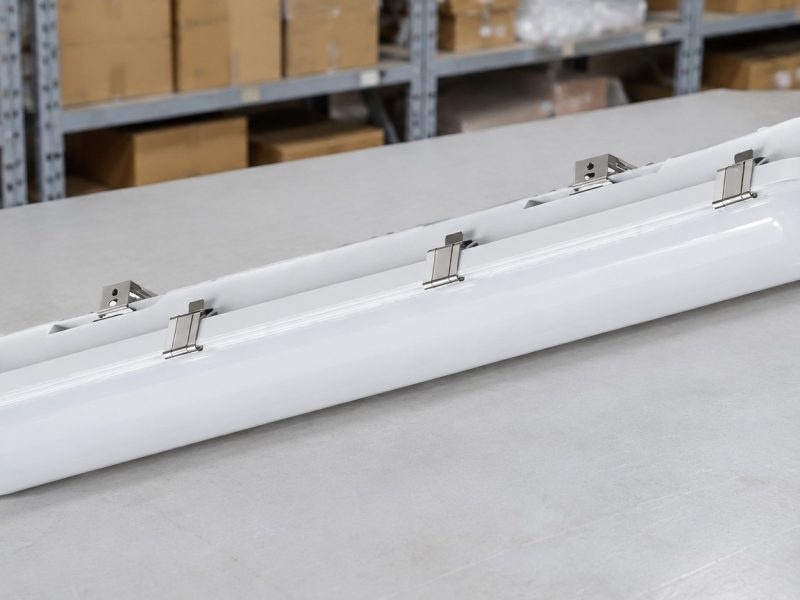
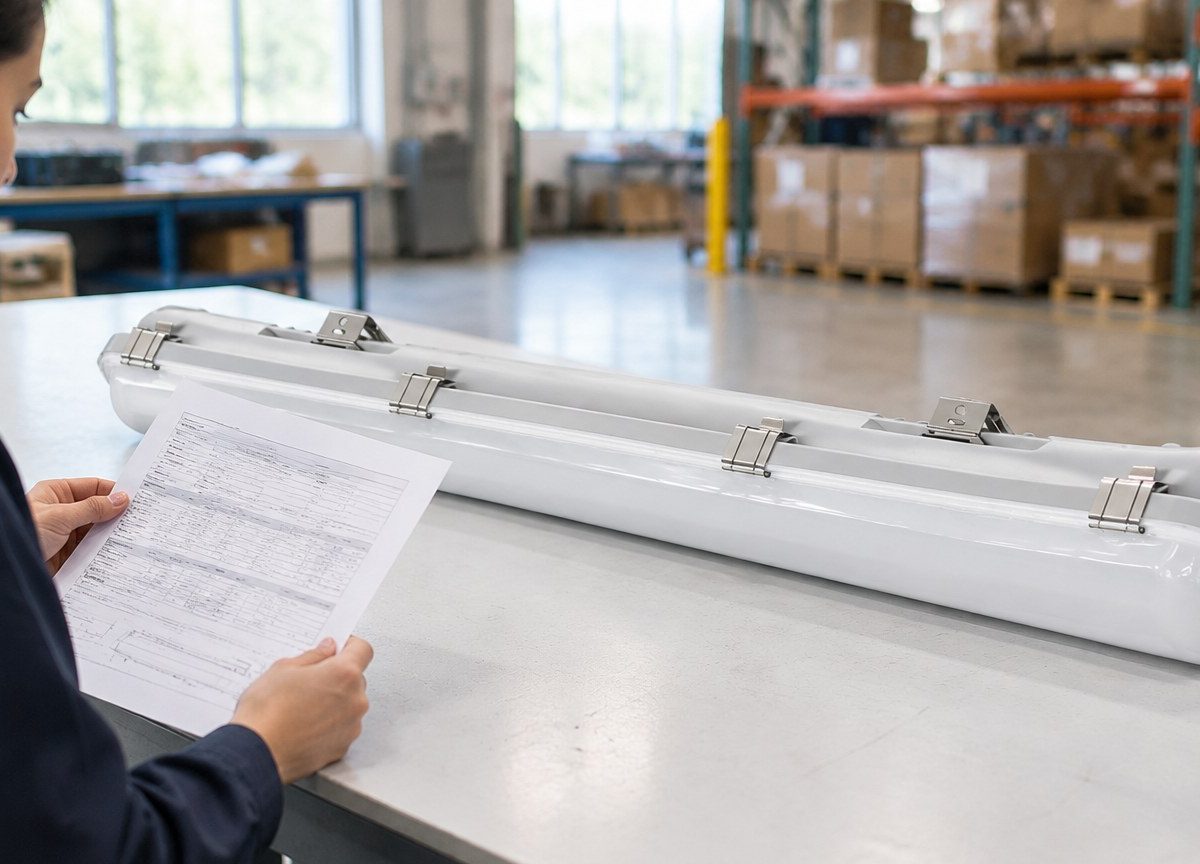
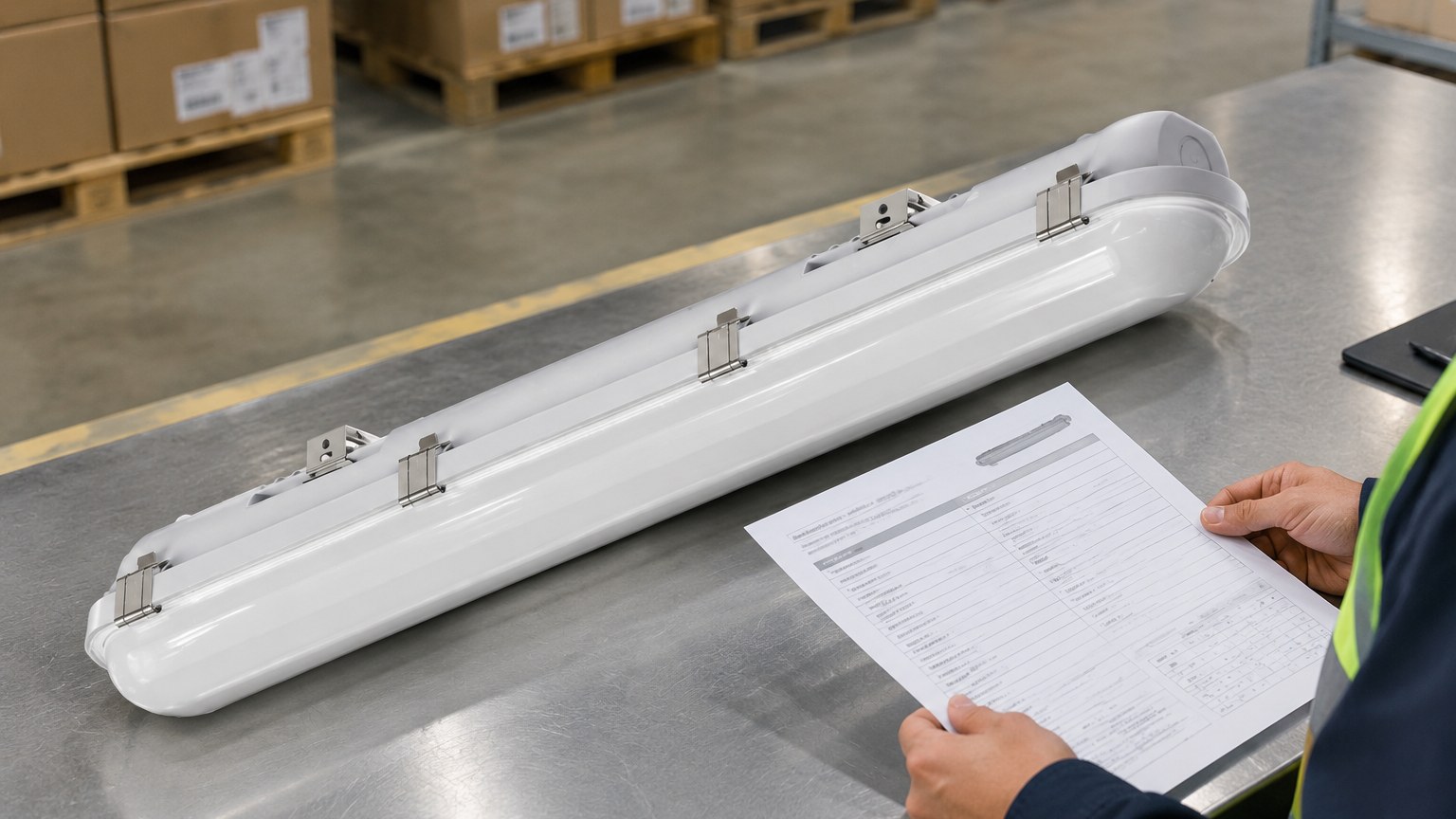
For preliminary product screening, CoolShinePro’s 4ft 36W LED vapor-tight fixture is a documented linear product with a PC housing and diffuser. Its record lists IP66, 200–240V AC at 50/60Hz, Ra 80 and 3000K/4000K/5000K options, with configuration-dependent controls. Those facts do not establish performance at every rack height.
A luminaire positioned 3 m above a low-level picking aisle and one installed 6 m above the floor are different layout cases. Use those heights as model inputs, together with aisle width and rack geometry, rather than assuming the same fitting count or spacing will work in both. Narrow aisles can also be shadowed by the top rack or by stock projecting beyond shelf edges.
The product record’s nominal length is not the fixing-centre dimension. Our 4ft bulk buying and specification guide explains how to distinguish the product class from actual housing dimensions, accessories and control versions. Ask for the selected configuration’s IES or LDT file and installation drawing in the same quotation package.
Do not translate the word “industrial” into an assumption that every linear fitting is a high-bay replacement. Evaluate useful light and service access at the actual installation height. Keep the proposed model identifiable throughout sample approval and layout revision.
Use a lumen estimate to compare assumptions, not approve a layout
An initial lumen-method calculation can expose the scale of a proposal. Consider an illustrative 20 m × 12 m storage area, or 240 m², with a chosen 200-lux average target. Assume 4,320 lumens per fixture, a utilization factor of 0.60 and a maintenance factor of 0.80.
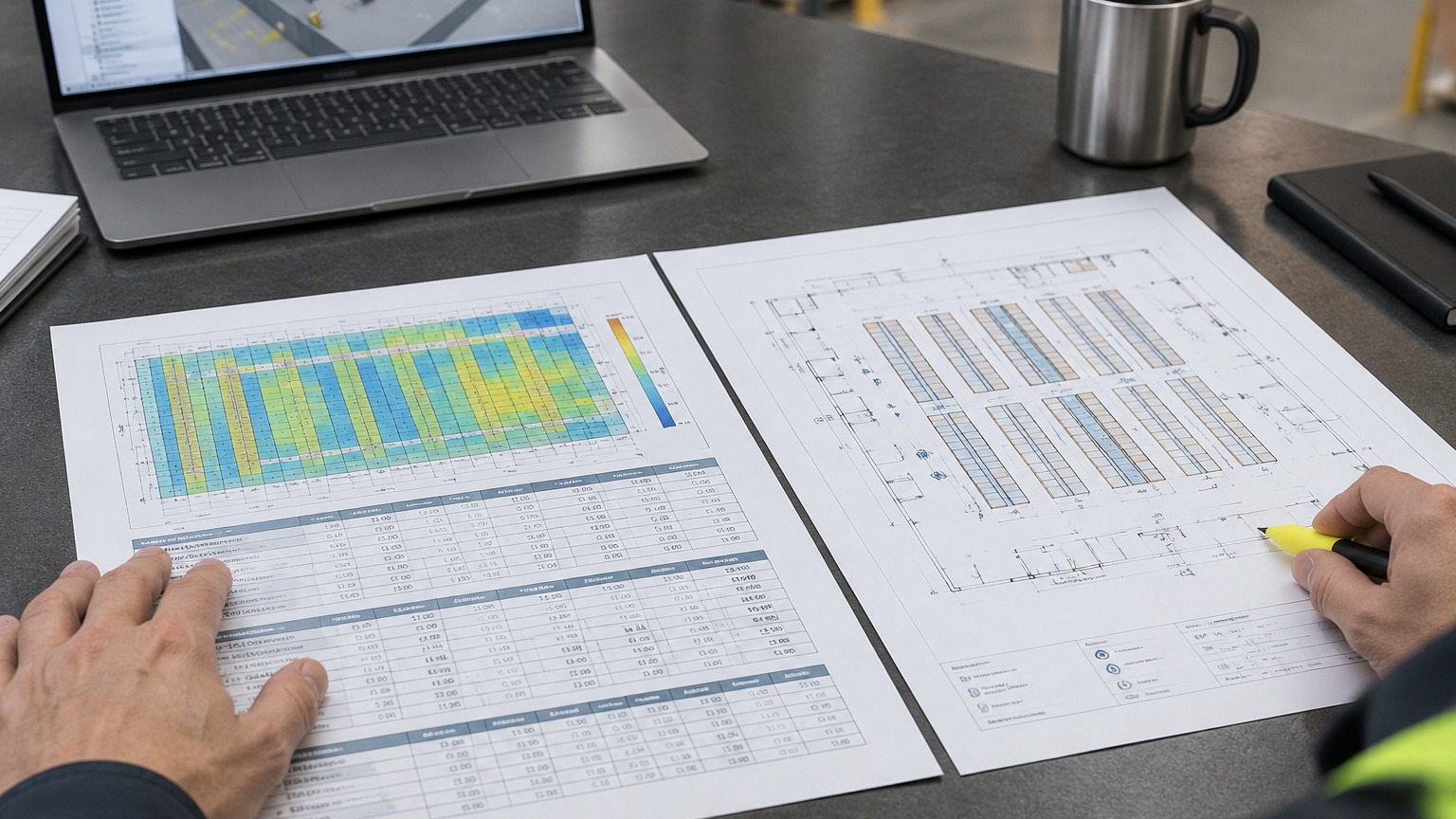
The preliminary quantity is 200 × 240 ÷ (4,320 × 0.60 × 0.80) = 23.15, rounded up to 24 fixtures. The 4,320-lumen input is an arithmetic example corresponding to 36W at 120 lm/W; replace it with the applicable measured luminaire output when preparing the design.
| Same 240 m² example | Preliminary fixture quantity | What changed |
|---|---|---|
| 200 lux; utilization 0.60; maintenance 0.80 | 24 | Starting comparison case |
| 200 lux; utilization 0.45; maintenance 0.80 | 31 | Less useful light reaches the target plane |
| 300 lux; utilization 0.60; maintenance 0.80 | 35 | A higher selected horizontal target |
These are arithmetic scenarios, not installation schedules. The estimate does not prove the vertical rack-face result, darkest point, glare or suitability of the beam distribution. A photometric model with the actual racking is the next purchasing checkpoint.
Specify protection and controls by warehouse zone
A dry picking aisle, a loading-door transition and a cleaning area can expose the fitting to different conditions. Record moisture, dust, cleaning method and ambient temperature for each. Use the IP65 versus IP66 comparison to discuss enclosure protection without assuming the IP code establishes chemical resistance or cold-start performance.
For vapor tight LED lighting with occupancy or daylight controls, define operating behaviour before requesting a sensor price. An example brief might call for 100% output during occupancy, a proposed 20% standby setting and a 10-minute delay. Those are requested behaviours to assess, not capabilities implied by a generic dimmable driver. Confirm whether the selected equipment can provide each function, including restart behaviour and any required control accessories.
At a constant full-load schedule, 24 × 36W = 864W. Running that load for 12 hours per day and 300 days per year gives 3,110.4 kWh annually. Actual dimmed energy use requires the driver’s power-versus-output data and an occupancy schedule; a 20% light setting should not simply be treated as 20% electrical power.
Build a B2B quotation and acceptance package
Split the bill of quantities by model, supply, CCT, control version, mounting arrangement and zone. For example, 18 non-dimming units plus 6 control-equipped units is more useful than a single line for 24 “warehouse lights.” Identify which locations each version serves and whether accessories are included.
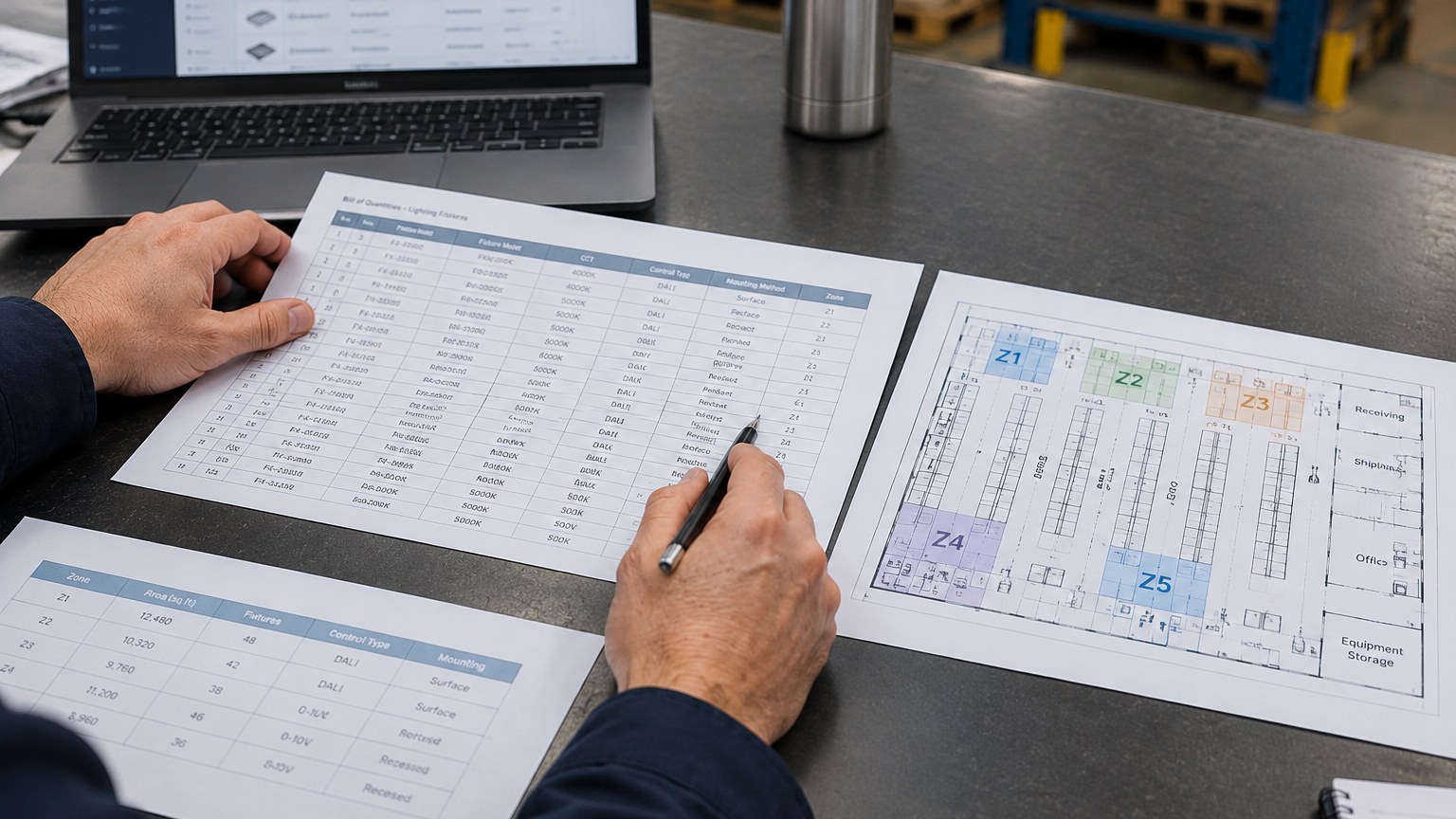
Require a drawing revision and a photometric-file identity alongside the price. The sample should match the agreed housing, diffuser, clips and driver configuration. Agree how representative rack faces and floor points will be measured after installation, and keep general warehouse lighting separate from emergency-lighting acceptance.
The tri-proof supplier sourcing guide covers manufacturer assessment and commercial comparisons. This warehouse article supplies the application brief that makes those quotations comparable. For a refrigerated zone, use the separate cold-storage lighting guide.
Frequently asked questions
Is 200 lux enough for every warehouse?
No. Storage, picking, rack-label reading and detailed bench work are different tasks. Specify the target plane and task criteria; a horizontal average does not describe vertical labels or the minimum value.
Can I replace a high-bay fixture with a 36W vapor-tight light?
Not on wattage alone. Compare the actual mounting height, distribution, output, layout and maintenance access. A documented linear fixture can be appropriate for some zones without being suitable for every high-level installation.
What does 0.40 uniformity mean?
For the minimum-to-average definition used here, the minimum is 40% of the average. At a 200-lux average, that ratio corresponds to 80 lux at the minimum point of the specified grid.
What should a warehouse lighting enquiry include?
Send rack and aisle dimensions, mounting heights, task locations, target illuminance, supply, cleaning conditions, required controls and quantities. Include the drawing revision so the layout and quotation refer to the same project.
Request a warehouse configuration review
Contact CoolShinePro with the warehouse plan and zone schedule to discuss an appropriate LED tri proof light fixture and supporting documentation. Keep rack-face performance, exact product configuration and the complete supply scope together when comparing samples and bulk quotations.