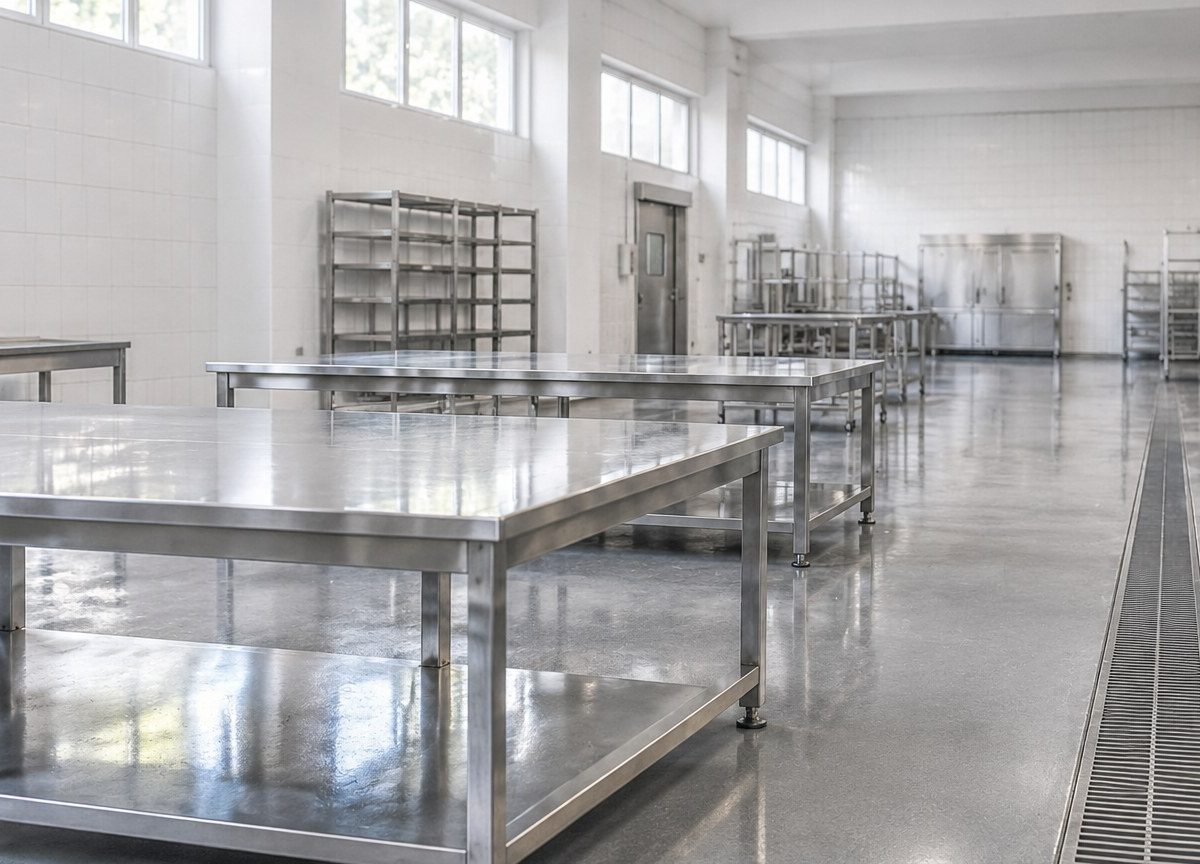
An IP69K LED tri-proof light is worth investigating when high-pressure, hot cleaning jets can reach the fitting. Start with the actual cleaning route, not the largest number on a catalogue. A ceiling fixture sheltered from jets and a wall fixture beside a wash station can face very different exposure in the same room.
Record three cleaning conditions separately
| Example location | Illustrative site record, not a test standard | What to check |
|---|---|---|
| Packing room | Wipe-down once per shift; no direct spray | Cleaning agents, surface compatibility and incidental splash |
| Wash bay perimeter | Ambient-temperature hose cleaning for 5 minutes per cycle | Whether direct jets reach the assembly and which jet test covers it |
| Processing line wash zone | Site specifies 80°C water and an 80 bar pump setting | Test standard, nozzle conditions, distance, angles and exact assembly tested |
The last row describes a hypothetical site brief. Pump pressure is not the measured pressure at a luminaire, and matching two numbers does not establish suitability. Obtain the cleaning procedure and confirm where the operator can direct the nozzle. If the fitting is moved behind a barrier, have the project team assess the revised exposure and resulting light distribution.

Compare the reports behind the labels
IP66 includes a powerful water-jet test. The IEC IPX9 designation and ISO IPX9K designation concern high-pressure, high-temperature jet tests under their respective standards. Ask which standard and edition the claimed rating refers to; a quotation saying only “IP69K waterproof” leaves that open. Also request evidence for the other water exposures the site needs rather than assuming the highest number covers every test.
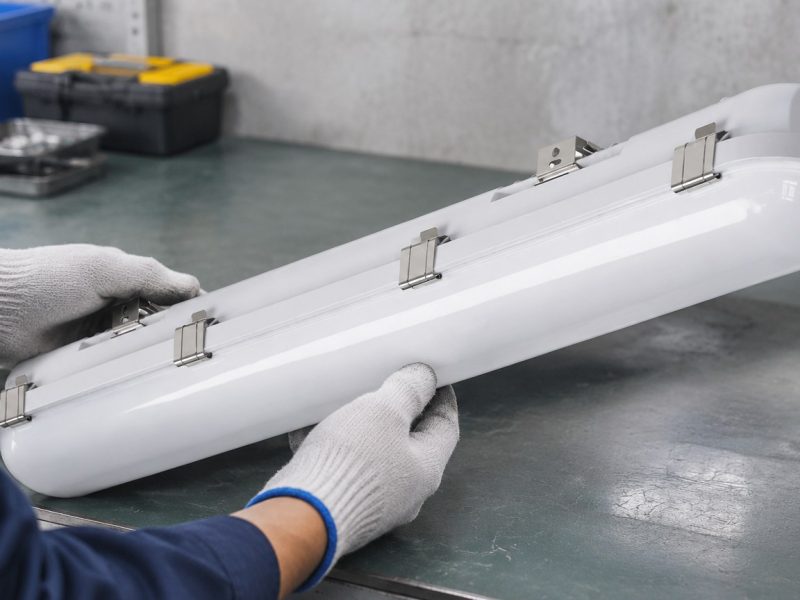
A complete report should identify the enclosure, seals, entry hardware, mounting arrangement and sample revision. Match those identifiers to the offered fitting and drawing. A separately rated gland or an empty housing report does not establish the completed luminaire rating. For background, see our IP65 and IP66 comparison.

Review exposure and access at the same time
Consider two sample positions: one 3 m above the cleaning floor and one 1.5 m above it beside a service door. The shorter height makes the fitting easier to reach but may place it within direct nozzle reach. Neither height alone is a pass criterion. Mark the cleaning path and the expected direction of spray on the drawing, then check obstructions and access for maintenance.
Track thermal and chemical exposure separately. A daily 10-minute cleaning cycle adds roughly 61 contact hours over 365 days, but repeated wetting, cooling and drying is not equivalent to a continuous 61-hour material test. Record the detergent, concentration, rinse and contact temperature. Check diffuser, gasket and metal hardware compatibility separately from water ingress.

Put acceptance criteria in the order
Request an installed-position drawing, exact model identifier, supported cable entries and the relevant whole-fixture reports. Ask the supplier to identify the proposed assembly and any differences between the sample and production order. Agree which positions require additional evidence, which can be sheltered, and which need a different fitting. Label an unverified offer as pending rather than treating a stronger marketing claim as an accepted specification.