A 4ft LED vapor tight fixture is a practical purchasing format for warehouses, service areas and other installations where a sealed linear fitting is appropriate. The useful comparison is between complete configurations: housing dimensions, input power, delivered light, ingress protection, controls and installation hardware. Two quotations labelled “4 foot LED vapor tight light” can cover different equipment.
For a concrete starting point, CoolShinePro’s 4ft 36W LED vapor-tight fixture provides a real product to discuss. This guide explains how to turn that starting point into a consistent sample request and bulk-order schedule, rather than choosing by length and unit price alone.
Specify the physical fitting, not just “4 foot”
Four international feet equal 1,219.2 mm: 4 × 304.8 mm. That conversion does not establish the overall length of a product sold in a nominal 4ft class. A catalogue may describe a fitting as 4ft or approximately 1.2 m while its housing, clips and installation envelope use separate dimensions. NIST defines the international foot as exactly 0.3048 m.
Write the required housing length, width, depth, fixing-centre distance and cable-entry position into the order drawing. For replacement work, record the existing fixing positions and available clearance. For a new installation, coordinate the selected fitting with the support system and intended maintenance access.
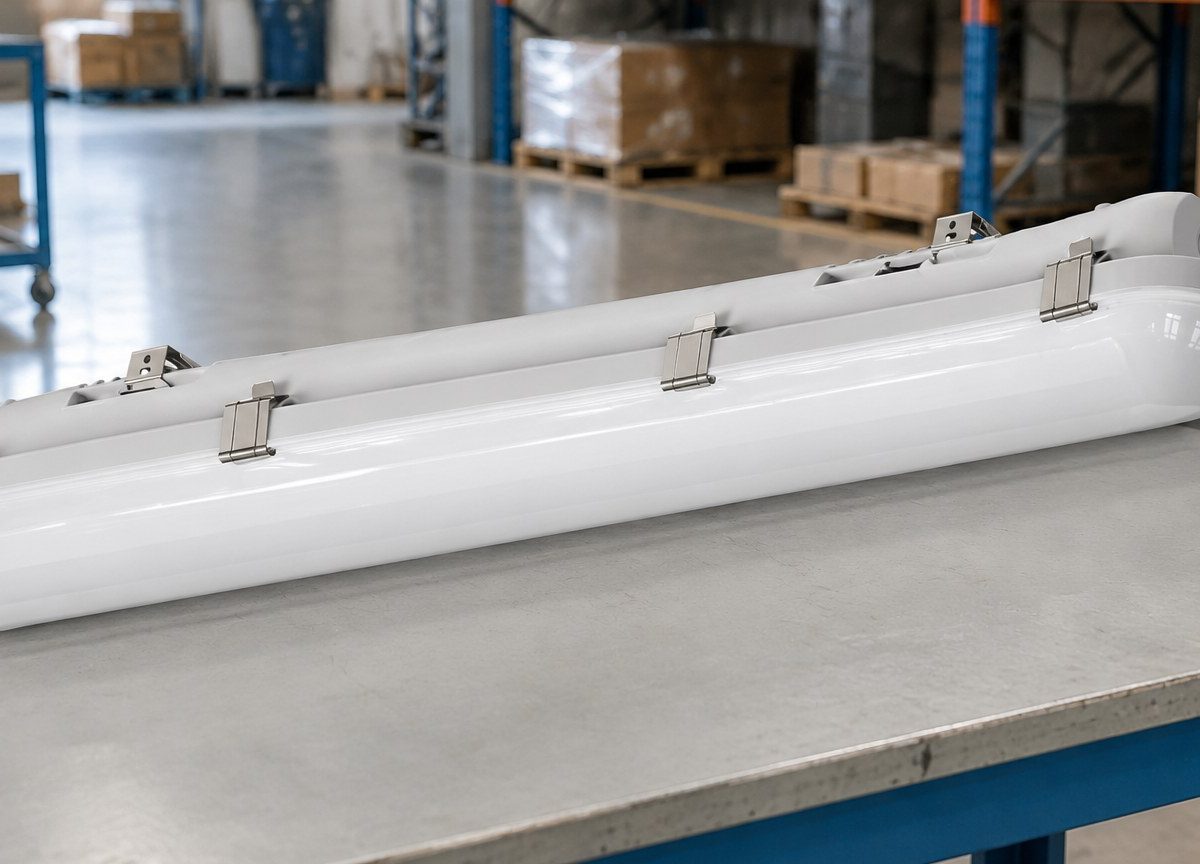
A nominal 4ft fixture and a 4ft replacement lamp are also different purchases. The first is a complete luminaire; the second may be only a light source for compatible equipment. State explicitly which item the quotation must cover, including driver, diffuser, clips and the specified mounting components.
Compare watts and lumens on one schedule
The current 4ft product record includes a 36W configuration, PC housing and diffuser, IP66, and a 200–240V AC, 50/60Hz input specification. Its listed colour-temperature options are 3000K, 4000K and 5000K, including a selectable-CCT option. The requested control version must be identified separately; a non-dimming unit and an optional 0–10V version are different order configurations.
Do not treat those choices as a promise that every combination is the same stock item. A useful quotation gives one line per agreed configuration, so a 4000K non-dimming sample is not silently substituted for a selectable-CCT dimming order.
| Buying decision | Specific numerical reference | What to put in the quotation |
|---|---|---|
| Nominal length | 4ft = 1,219.2 mm as a unit conversion | Actual housing dimensions and fixing centres on the selected drawing |
| Input power | 36W for the discussed configuration | Complete-fixture input power for that exact version |
| Light-output comparison | 36W × 120 lm/W = 4,320 lm | Model-specific luminaire output and its photometric file |
| Supply compatibility | 200–240V AC; 50/60Hz | Required supply range and frequency, rather than an unspecified “universal” input |
| Fixed colour temperature | 3000K, 4000K or 5000K | One selected CCT per line item, or the expressly ordered selectable version |
| Dimming | Optional 0–10V configuration | Exact control version and the compatible control arrangement |
| Ingress protection | IP66 | Supporting protection documentation for the supplied enclosure configuration |
The 4,320-lumen figure above is the arithmetic result of 36W at 120 lm/W. It is a comparison reference, not a replacement for the selected model’s measured photometric data. Lumens describe fixture output; lux describes light reaching a surface. For example, 50 fixtures × 4,320 lm = 216,000 source lumens, but that total cannot establish warehouse-floor illuminance without room geometry, mounting height, distribution and light-loss assumptions.
Where the application is a parking structure, use our parking-garage tri-proof lighting guide for the separate questions of circulation routes, columns and useful visibility.
Match IP protection to the actual cleaning conditions
In IP66, the first 6 means dust-tight protection; the second 6 addresses powerful water jets under the applicable test conditions. It does not turn a linear light into an immersion-rated fitting or establish resistance to every cleaning chemical. Intertek’s ingress-protection testing overview distinguishes these water-exposure classes.
Use the exposure description to compare the enclosure, seals, clips, cable entry and installation arrangement together. A warehouse with occasional moisture is a different brief from a frequently washed service area. Temperature, cleaning agents and the way water reaches the fitting belong in the enquiry, alongside the IP code.
Our IP65 versus IP66 lighting comparison explains the protection distinction in more detail. Keep any additional requirements, such as impact resistance or hazardous-area suitability, separate from the water-protection selection.
Put operating cost beside the fixture price
For a purchasing example, compare 50 complete fixtures operating 12 hours per day for 300 days per year. That is 3,600 operating hours annually. The table compares two input-power scenarios at the same quantity and operating time; it does not establish that the two scenarios provide equivalent lighting.

| Comparison item | Scenario A: 36W per fixture | Scenario B: 50W per fixture |
|---|---|---|
| Fixture quantity | 50 | 50 |
| Connected load | 1.8 kW | 2.5 kW |
| Annual operating time | 3,600 hours | 3,600 hours |
| Annual electricity use | 6,480 kWh | 9,000 kWh |
| Electricity cost at an example $0.12/kWh | $777.60 | $1,080.00 |
The arithmetic difference is 2,520 kWh, or $302.40 per year at the example tariff. Calculate energy as quantity × watts ÷ 1,000 × operating hours. Use the project’s actual tariff and schedule when preparing a budget.
A lower-wattage configuration is useful only if its photometry and layout satisfy the task. Compare purchase price, accessories, installation and operating cost after checking lighting performance. For spaces operating at low temperature, the cold-storage lighting guide covers additional environmental and installation considerations.
Approve a sample configuration before splitting a bulk order
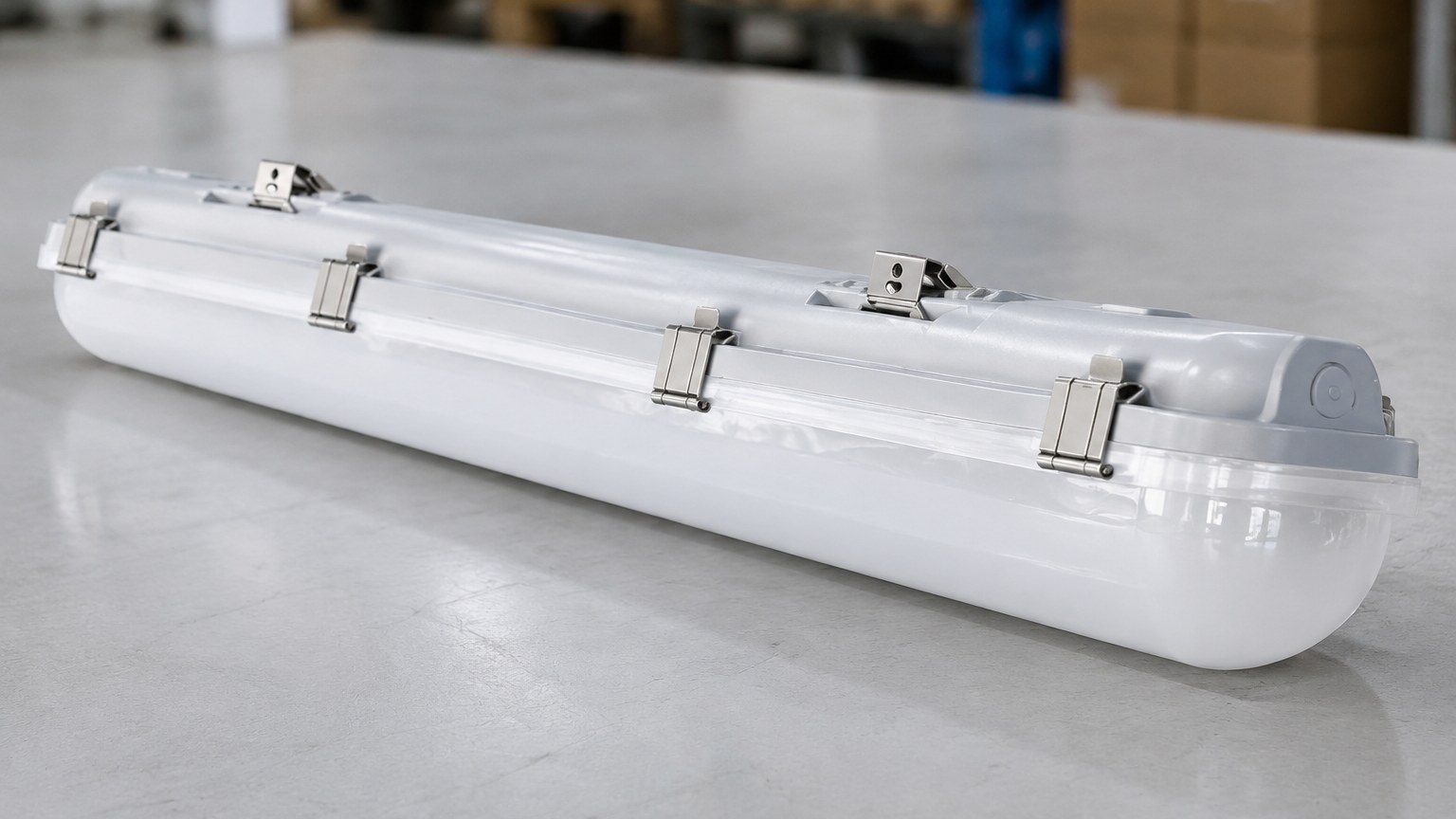
Build the sample order around the same model, CCT, driver version, enclosure and mounting components intended for production. Photograph the actual supplied product and record its identity. That reference makes later discussions about diffuser shape, clip arrangement and cable entry much clearer than exchanging generic catalogue pictures.

For an illustrative 100-unit order split equally between 4000K and 5000K, list 50 units of each as separate lines. If ten of the units require a different control configuration, identify those ten explicitly within the relevant CCT lines. A total of 100 units alone leaves the configuration split unresolved.
Check sample dimensions against the drawing, confirm the ordered input and controls, and review the light-output information with the intended layout. Then agree packaging, inspection criteria and the configuration list used for production acceptance. Our tri-proof supplier selection guide provides the wider supplier-comparison framework.
Frequently asked questions
Is every 4ft LED vapor tight fixture exactly 1,219.2 mm long?
No. 1,219.2 mm is the exact conversion of four international feet. A nominal product class does not specify the complete housing or its fixing-centre distance. Use the selected model’s dimensional drawing for installation coordination.
Does a 36W fitting always produce 4,320 lumens?
No. 36 × 120 = 4,320 is the calculation at an assumed or specified efficacy of 120 lm/W. The output of the ordered configuration must come from its applicable photometric information. Driver, optics and configuration differences matter.
Should I order 3000K, 4000K or 5000K?
Choose the CCT required by the project and keep that selection consistent with the sample and order schedule. A 3-CCT selectable version is a distinct configuration; its presence should be written into the quotation rather than inferred from a product-family description.
Does IP66 include an emergency-lighting function?
No. IP66 describes ingress protection. If emergency operation is required, specify the required duration, emergency output, relevant testing and acceptance requirements separately, then identify an appropriate documented configuration.
What should I send for a bulk quotation?
Send the quantity by configuration, installation drawing or dimensions, supply, selected CCT, control requirements, exposure and cleaning conditions, and delivery destination. Include the model or reference photograph so the quotation covers the same physical product throughout.
Request a configuration-based quotation
For 4 foot LED vapor tight fixtures, start with the real fitting and a clear schedule: nominal length, actual dimensions, 36W or another specifically agreed power, supply, CCT, controls, IP requirement, quantity and mounting components. Contact CoolShinePro with those details and the reference product to request an itemised sample or bulk quotation.