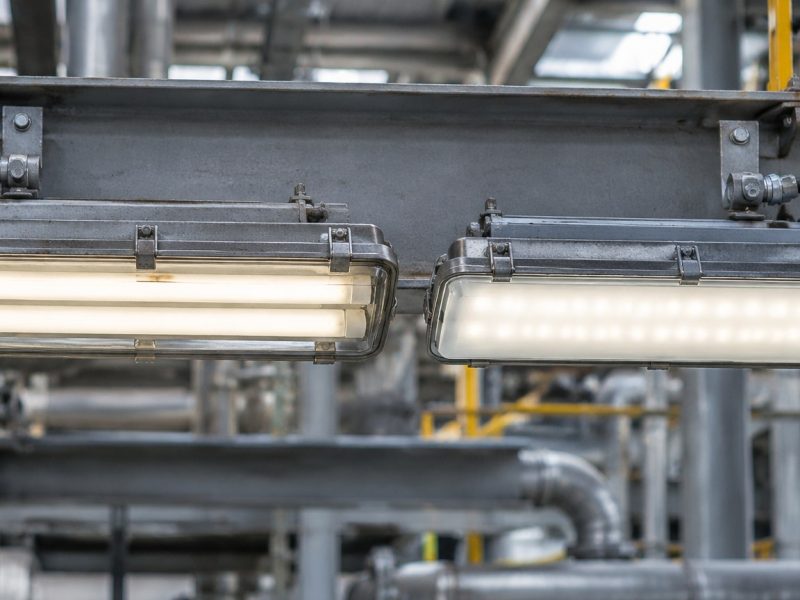
A vapor tight LED retrofit should improve the lighting result and the operating budget together. Replacing a fluorescent vapor tight fixture with a lower-wattage product is not enough if the new installation loses visibility, leaves damaged enclosures in service or creates incompatible maintenance stock.
For facility owners and electrical contractors, the investment case starts with measured complete-system power, annual operating hours, the electricity tariff and an installed quotation. This guide uses a transparent 100-fitting calculation to compare retrofit options without promising a universal saving or payback period.
Survey the existing installation before pricing replacements
Record each existing fitting type, lamp count, ballast, supply, mounting position and enclosure condition. Separate standard, controlled and emergency fittings. Note whether covers are discoloured, clips broken or cable entries damaged. A lamp-only budget is not credible when significant parts of the enclosure population need replacement.
For example, divide 100 surveyed fittings into 70 sound enclosures, 20 with damaged covers or clips, and 10 requiring further inspection. Those are example survey findings, not expected failure rates. They show why one replacement strategy may not fit the whole site.
Record task-area illuminance and poor-visibility locations before works. A dirty, underlit installation is not an acceptable performance target simply because the existing electrical load can be measured. Agree the required maintained lighting result first, then compare replacement proposals against it.

For warehouse projects, our racking and picking-aisle guide separates floor and shelf tasks. For other applications, establish the relevant local and task requirements rather than copying a warehouse target.
Use measured input instead of lamp-marking arithmetic
Two fluorescent lamps marked 36W each total 72W of nominal lamp power. They do not prove that the complete fitting draws exactly 72W. Ballast and system behaviour must be included. Have a qualified person measure representative complete fittings safely and record the instruments and operating conditions.
The main calculation below assumes an existing 80W system input and a replacement 36W complete-fitting input. The old value is a calculation assumption, not a claim about every twin-36W fixture. Use the offered product’s verified system power for the new value.
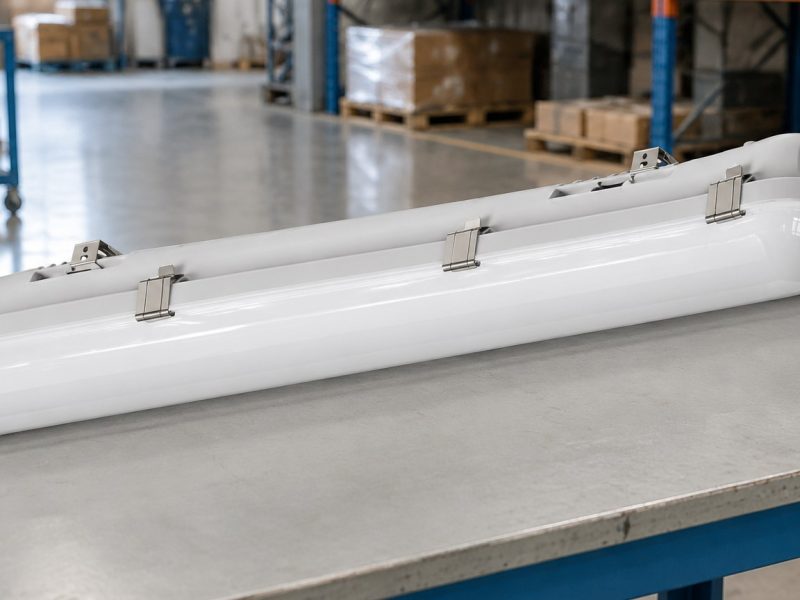
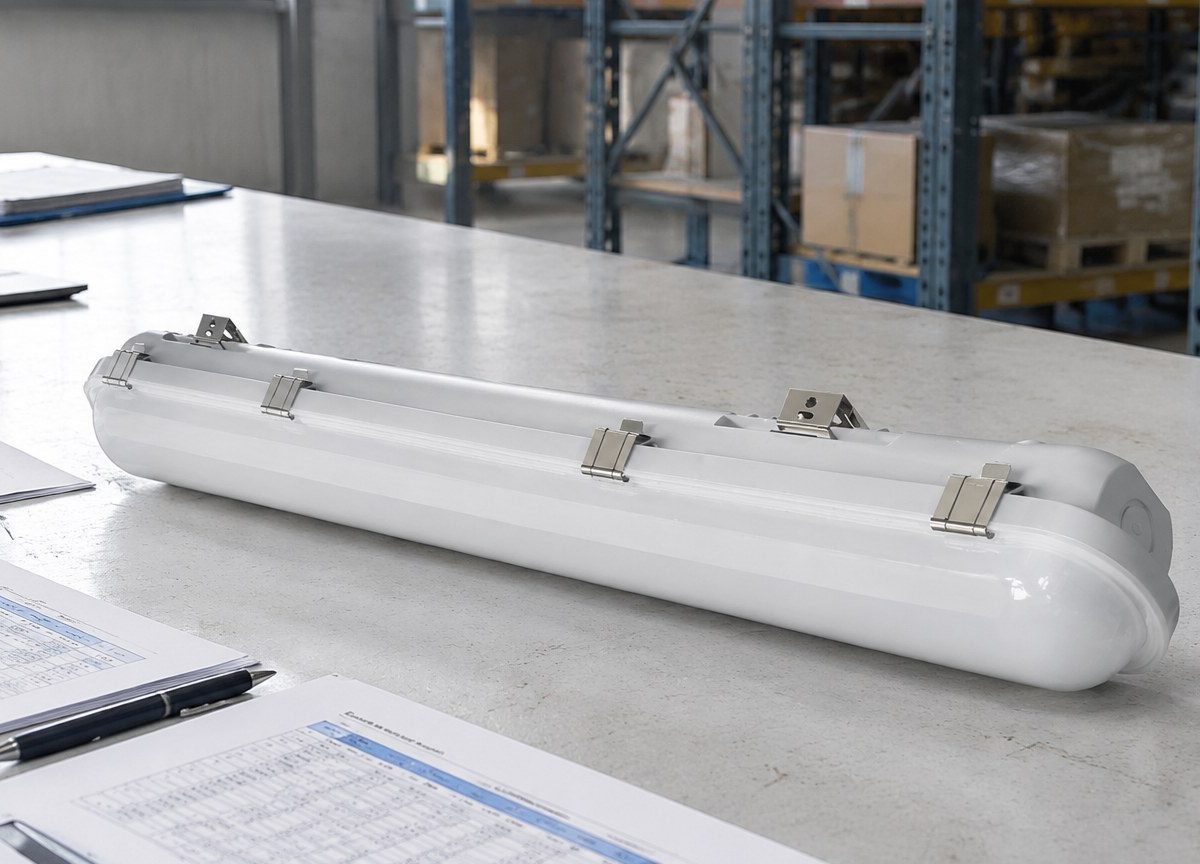
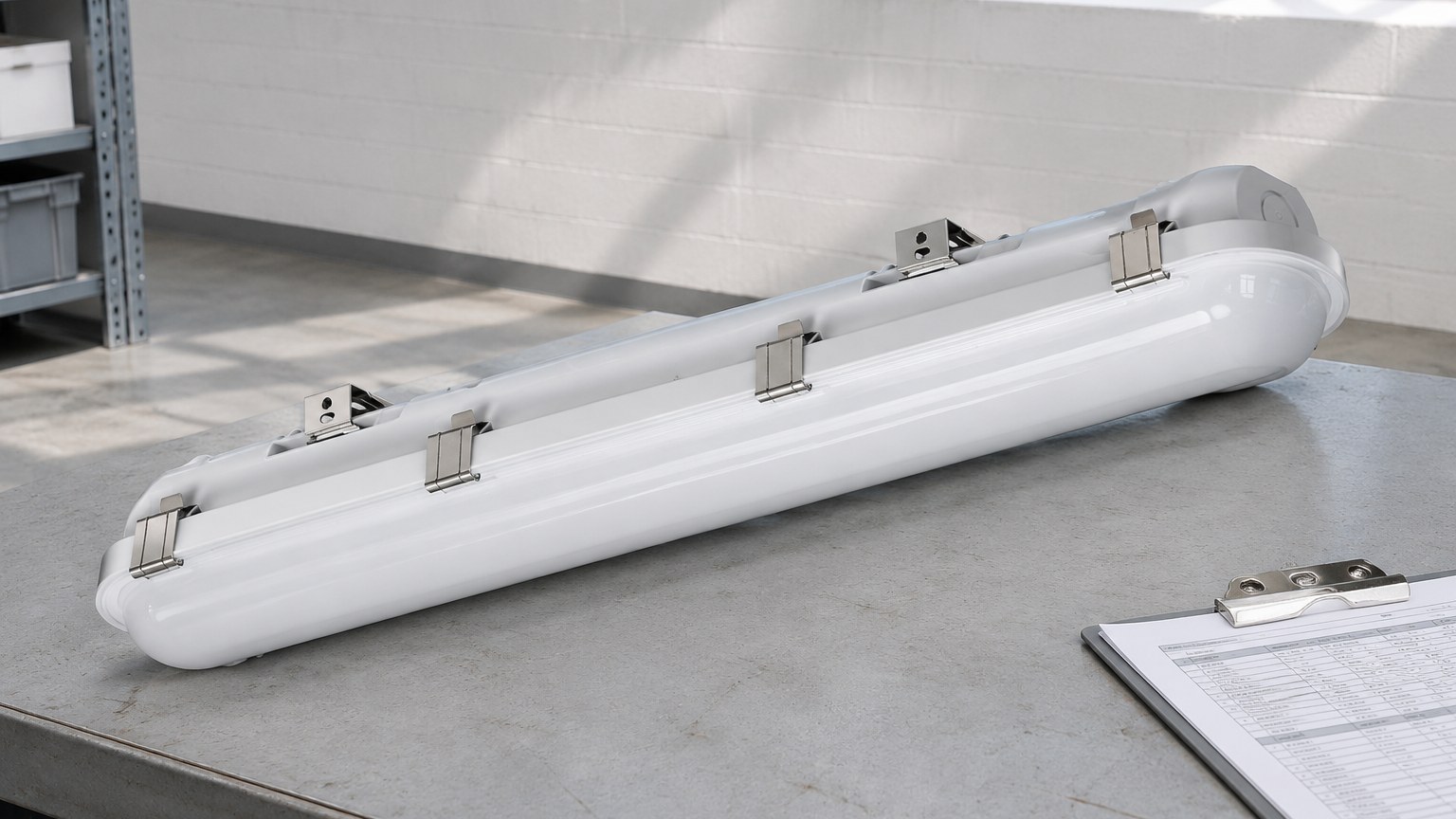
CoolShinePro’s documented 4ft 36W LED vapor-tight fitting is a starting point for a new-fitting proposal. Its listed supply is 200–240V AC, 50/60Hz, with IP66 and PC construction. That supply range must match the installation; a different voltage needs a separately confirmed solution.
Calculate the annual saving for 100 fittings
Assume 100 fittings, 12 hours per day, 300 operating days, and a flat illustrative tariff of $0.15/kWh. Annual operation is 3,600 hours. Keep the fitting count unchanged initially, subject to a lighting-design check.
| Measure | Existing system | Proposed LED system | Difference |
|---|---|---|---|
| Complete-fitting input | 80W | 36W | 44W |
| Installed quantity | 100 | 100 | 0 |
| Connected load | 8.0 kW | 3.6 kW | 4.4 kW |
| Annual operating hours | 3,600 | 3,600 | 0 |
| Annual electricity | 28,800 kWh | 12,960 kWh | 15,840 kWh saved |
| Annual energy cost | $4,320 | $1,944 | $2,376 saved |
The equations are:
Annual energy saving = quantity × (old W − new W) ÷ 1,000 × annual hours.
Annual energy-cost saving = annual kWh saved × the applicable energy tariff.
The calculated energy reduction is 44 ÷ 80 = 55% in this example. It is not a guaranteed project saving. If the actual old load is 60W, the same 36W replacement reduces power by 40%, not 55%.
If the redesigned layout needs 110 new fittings, annual LED consumption becomes 14,256 kWh, and the saving falls to 14,544 kWh, or $2,181.60 at the same tariff. Include the extra ten fittings in the investment as well. Equal fixture counts should never be forced at the expense of the lighting brief.
Compare lamp conversion and complete replacement on one scope
A retrofit can retain suitable housings or replace the complete fitting. In North American terminology, Type A tubes retain a compatible ballast, Type B uses a bypass arrangement and Type C uses an external driver. The UL retrofit FAQ explains the importance of the identified host luminaire and the kit instructions. A lamp’s physical fit alone is not approval for a conversion.
The following are hypothetical installed budgets for the same 100 positions, assuming both proposals achieve the required lighting result. They are not CoolShinePro prices or measured product comparisons.
| Budget and performance assumption | Lamp/kit conversion | Complete new fittings |
|---|---|---|
| Verified system power assumed for calculation | 40W | 36W |
| Equipment budget | $2,000 | $3,500 |
| Installation labour | $1,000 | $1,500 |
| Access, disposal and related works | $500 | $500 |
| Total installed investment | $3,500 | $5,500 |
| Annual energy-cost saving versus 80W | $2,160 | $2,376 |
| Energy-only simple payback | 1.62 years | 2.31 years |
In this calculation the conversion has a shorter payback, while the new fittings use less electricity. The additional $2,000 invested in full replacement saves an extra $216 per year in energy, giving an incremental energy-only payback of 9.26 years. Maintenance, enclosure condition and lighting quality may justify the difference, but those benefits need their own evidence.
For enclosure and serviceability selection, our 4ft specification guide provides a product-order checklist. Avoid assuming an old fluorescent vapor tight fixture keeps its ingress performance after arbitrary rewiring or component substitution.
Test the variables that can change the decision
Holding the $5,500 investment, 100 fittings and 80W-to-36W change constant gives the following sensitivity table. It excludes maintenance savings, incentives, financing and tax.
| Operating scenario | Annual kWh saved | Annual energy-cost saving | Simple payback |
|---|---|---|---|
| 2,000 h/year at $0.10/kWh | 8,800 | $880 | 6.25 years |
| 3,600 h/year at $0.15/kWh | 15,840 | $2,376 | 2.31 years |
| 5,000 h/year at $0.25/kWh | 22,000 | $5,500 | 1.00 year |
This is why a universal “one-year payback” promise is unhelpful. The same assumed installation spans 1.00 to 6.25 years under these operating conditions. Use a tariff model appropriate to your business; demand charges, time-of-use rates and fixed charges are not all avoided simply because kWh decreases.
Controls should be modelled separately. If an LED-only control schedule reduces equivalent full-output hours from 3,600 to 3,000, a 3.6kW system uses 2,160 fewer kWh, worth $324 at $0.15/kWh. Include controller cost and verify operating behaviour. Do not add that saving again if the lower hours are already included in the baseline comparison.
Keep maintenance savings separate from energy savings
Suppose service records support $300 per year of avoided maintenance after allowing for expected LED service costs. Adding that to the $2,376 energy saving gives $2,676 total annual saving and 2.06-year simple payback on $5,500. Without those records, retain the 2.31-year energy-only case.
The US Department of Energy’s retrofit financial tool, developed for street and parking-facility projects, separately considers energy, maintenance and financial outcomes. It is a useful reminder to distinguish simple payback from a fuller lifecycle assessment; its sample inputs are not default values for this installation.
Approve a pilot and then release the bulk order
Use an illustrative four-position pilot covering a representative aisle, work area and difficult access location. Check measured input, the agreed illuminance points, start-up, control behaviour, mounting and safe maintenance access. A four-position pilot validates selected conditions; it does not replace complete project commissioning.

Record final order codes, quantities and accessories before releasing production. Have qualified installers handle conversion or replacement according to the approved documentation. Keep emergency and hazardous-area work on separately specified schedules; a general-purpose tri-proof fitting does not establish emergency or explosion-protection compliance.
To request a retrofit proposal, send CoolShinePro the survey, measured loads, operating schedule, tariff, lighting targets and site photographs through our contact page. A usable quotation should identify the new configuration and installed scope so that the energy model can be updated with real project figures.