
An emergency LED panel light with battery backup has two performance schedules: normal lighting and emergency operation. A 40 W description does not establish emergency output, autonomy or the battery arrangement. Compare these separately before agreeing a project price.
For a 600 × 600 panel or a 2 × 4 ft panel, first identify the actual format. They are different dimensions, not interchangeable descriptions. Emergency-system design and acceptance must follow the project jurisdiction and responsible designer’s requirements.
Define the emergency function
Eaton’s emergency-lighting fundamentals distinguishes maintained and non-maintained operation. Specify whether the project needs a normal-use panel with an emergency function or a separate dedicated emergency fitting.
Put normal input, normal lumens, emergency lumens, duration and testing on separate quotation lines. Driver watts are not interchangeable with delivered emergency lumens; neither alone proves illumination on an escape route.
Compare output and duration together
This hypothetical quotation table is not a CoolShinePro specification or a universal emergency-lighting target.
| Example offer | Normal input | Emergency output | Rated duration | Additional checks |
|---|---|---|---|---|
| A | 40 W | 250 lm | 1 hour | Required autonomy, distribution and route calculation |
| B | 40 W | 180 lm | 3 hours | Required autonomy, distribution and route calculation |
| C | 40 W | 300 lm | 3 hours | Compatible battery, driver and panel; route calculation |
At constant stated outputs, A provides 250 lumen-hours, B 540 and C 900. This is arithmetic, not a compliance metric. It establishes neither spacing nor floor illuminance, and does not prove output at the end of the duration.
Longer duration can accompany lower output in some configurations. Obtain emergency photometric data and the declared performance throughout rated operation. A high initial reading does not replace an end-of-duration check.
Sense-check battery energy and ancillary input
An illustrative battery marked 6.4 V and 3 Ah has nominal energy of 19.2 Wh. Assuming 75% is available to the load in a preliminary calculation gives 14.4 Wh. A constant 4 W load uses 12 Wh over 3 hours.
This does not validate a battery or establish autonomy. Ageing, temperature, discharge characteristics, driver efficiency, cutoff and approved component combinations matter. A greater nominal Wh rating does not authorize substituting a different pack.
For 50 panels, an assumed additional continuous charging and standby input of 1 W each totals 50 × 0.001 × 8,760 = 438 kWh annually. At $0.15/kWh, that is $65.70. Obtain actual ancillary input for the offered configuration rather than comparing normal watts alone.
Check ceiling fit and maintenance access
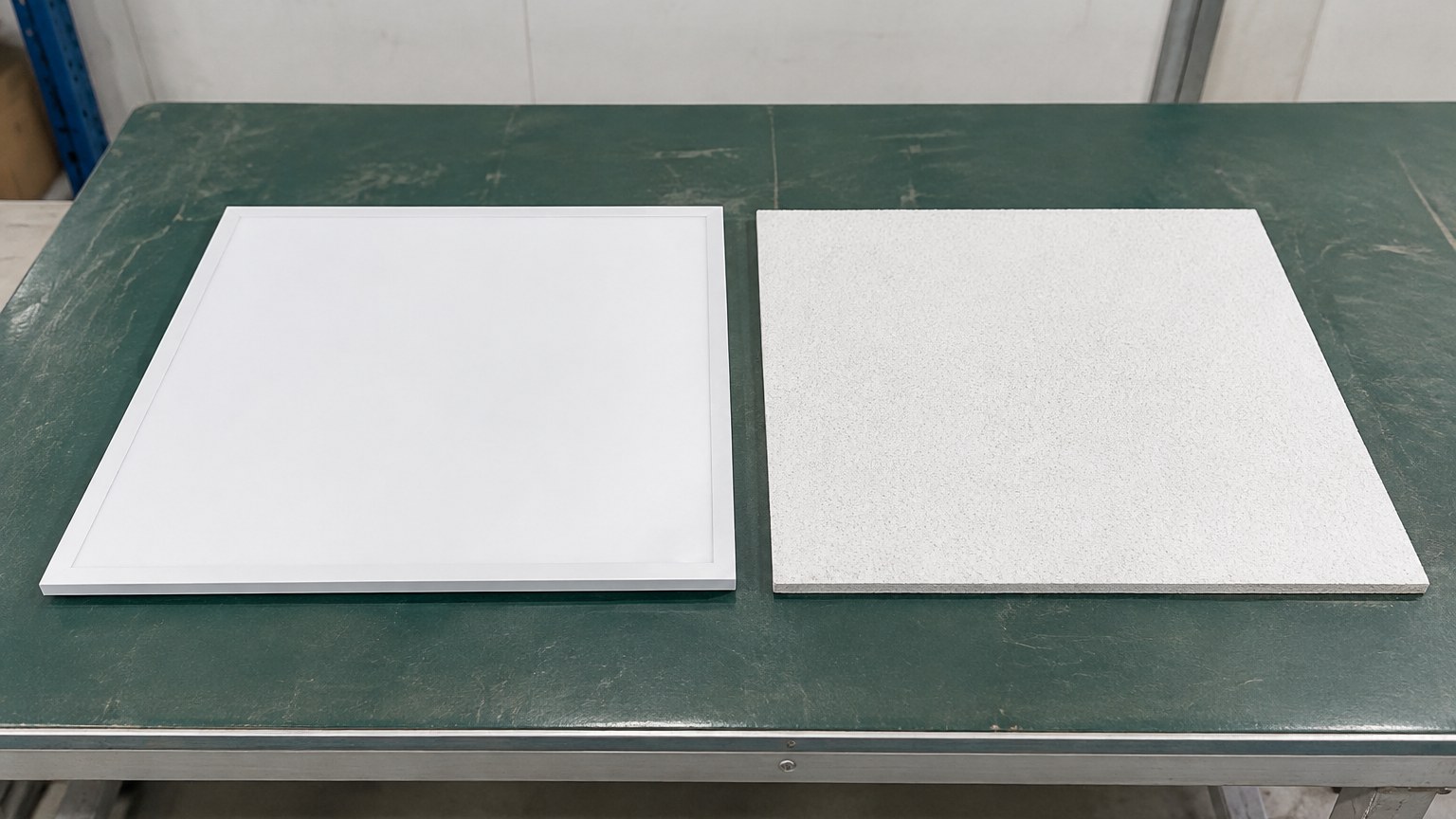
A nominal 600 × 600 ceiling module does not establish panel body dimensions. A 2 × 4 ft description likewise does not establish metric-grid compatibility. Verify the cutout, support, service depth and access to the emergency components.
A hypothetical 595 mm panel in a 600 mm opening leaves a 5 mm total difference, or 2.5 mm per side when centred. This alone does not establish support or installation suitability. See our panel size guide for the wider comparison.
Specify how the approved battery and emergency driver will be reached for replacement without damaging the ceiling. Follow the approved installation arrangement rather than inventing a configuration for a shallow void. The drawing and maintenance instructions should identify required service space.
Confirm the panel and emergency option separately
CoolShinePro’s 40 W 600 × 600 panel is a documented normal-lighting reference. Its standard specifications do not automatically confirm a battery option. Request the separately identified compatible emergency assembly and evidence before ordering that function.
Normal dimming is separate from emergency behaviour. Controls must not prevent the required emergency function. For normal-use interfaces, use our dimmable panel buying guide.
Include testing and handover in the offer
Request commissioning, charging requirements, function and duration test methods, fault indication and replacement information. Distinguish automated testing from human inspection and from the records needed for project acceptance.

For example, 60 panels at an assumed 3 minutes of hands-on recording each require 180 minutes, or 3 staff-hours. This excludes waiting, travel and access. A duration test can have a much longer elapsed time; the recording time is not the whole test duration.
Keep a location schedule identifying the panel, emergency driver, battery revision and records. Later replacement purchases are more reliable with those identifiers than with a generic emergency-panel order line.
Request a complete project quotation
Provide quantity, ceiling format, supply, normal-lighting needs, emergency design brief, autonomy and testing requirements. Ask the vendor to identify included items, optional items and the exact assembly.
Compare normal lighting separately with our panel wattage guide. Approve emergency capability only after its documented performance and installation arrangement match the project requirements.