
Cold-storage lighting should be selected around the lowest operating temperature, cold starting, moisture transitions and the visual task. A fixture whose stated ambient range stops at −10°C is outside that range in a −20°C room, even if its enclosure is IP65. Temperature capability and ingress protection therefore need to be specified separately.

The most useful purchasing outcome is a clear specification and a comparable quotation. A list of products labelled “cold room lights” is only a starting point.
1. Define the Conditions in Each Storage Area
Use the actual coldest temperature at the mounting point, rather than a general label such as cold room. For a planning example, a −20°C store beside a +5°C preparation area creates a 25°C temperature difference. That example is not a recommended storage temperature; it illustrates why door openings and warm-air entry can produce very different moisture conditions from a steadily cold aisle.
Prepare a short area schedule before requesting products. Include chilled storage, freezer storage, loading interfaces and any separate packing or inspection areas relevant to the project. Record their conditions individually rather than applying one specification to the entire facility.
For each area, identify:
- The expected temperature range at the mounting position.
- Whether lights operate continuously or switch off between visits.
- Door-opening patterns and transitions between spaces.
- Mounting height, rack arrangement and the work performed there.
- Cleaning methods and any cleaning chemicals used around the fittings.
Room setpoints alone may not describe the luminaire’s actual environment.
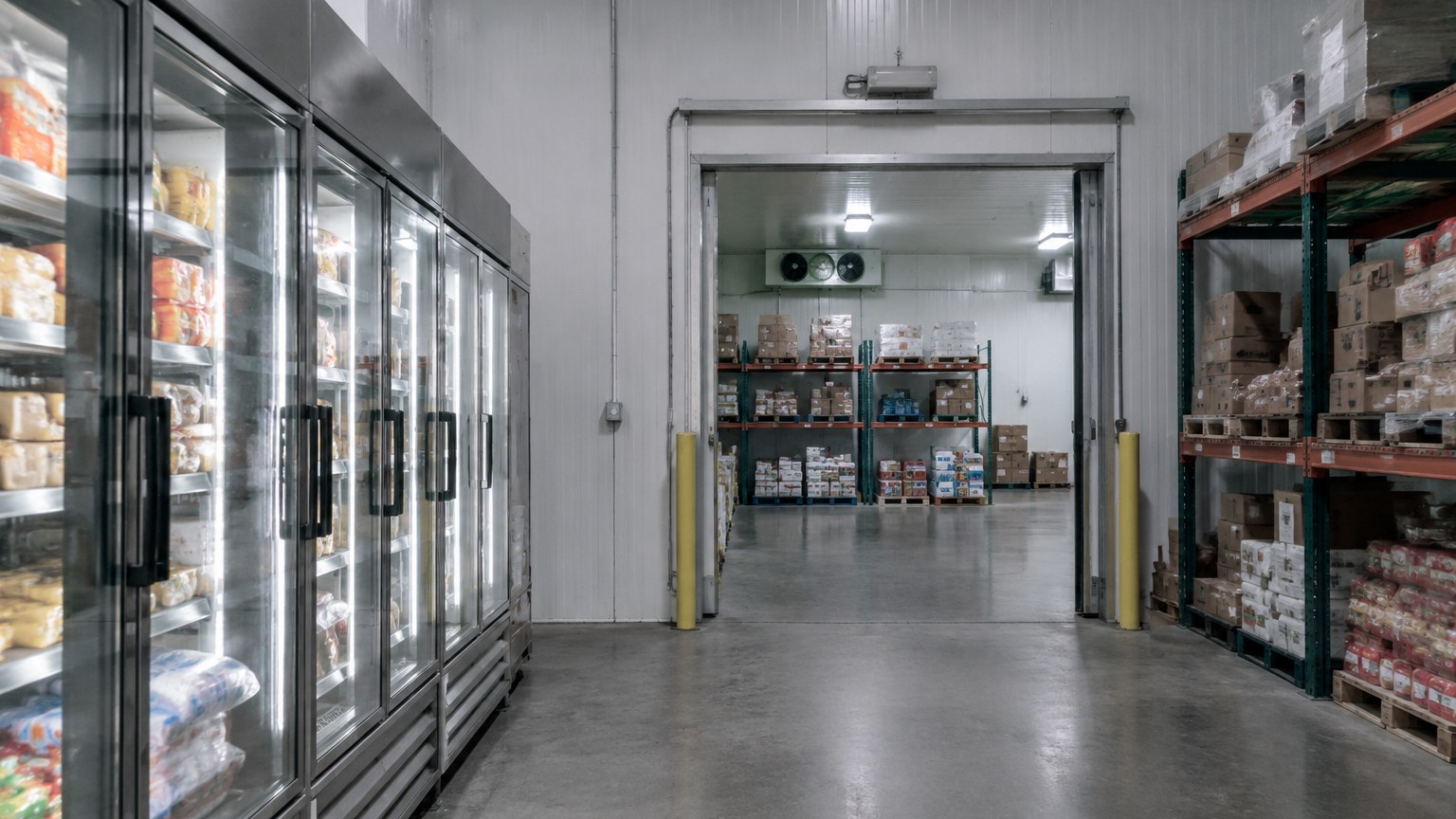
Thorlux’s cold-store guidance notes that high-level temperatures can differ from those near the floor, particularly around ceiling-mounted refrigeration equipment. Use site information relevant to where the fittings will be installed. Source: Thorlux Cold Stores
2. Verify Low-Temperature Operation and Starting
Separate these purchasing questions:
The following temperature-screening example holds the room at −20°C and changes the fixture’s declared lower ambient limit. It is a range check, not a complete cold-store approval or a recommended storage temperature.
| Comparison dimension | Fixture A example | Fixture B example | Practical interpretation |
|---|---|---|---|
| Room temperature used for the comparison | −20°C | −20°C | Same installation condition |
| Declared minimum ambient temperature | −10°C | −30°C | Use the complete fixture’s actual rating, including the driver |
| Distance from the lower limit | Room is 10°C below the limit | Room is 10°C above the lower limit | A is outside its stated range; B passes this lower-limit check only |
| Cold-start requirement | Starting at −20°C remains necessary | Starting at −20°C remains necessary | A steady-running rating alone does not demonstrate starting performance |
| Moisture transition example | −20°C store to +5°C adjoining space | Same 25°C difference | Assess condensation, seals and the actual cleaning process separately |
Describe the intended switching pattern in the enquiry.

A proposal for continuously operated lighting should not silently become the basis for an installation that switches frequently or must restart after a cold shutdown.
Orion’s cold-storage selection guidance similarly advises matching temperature ratings to facility conditions rather than assuming that any LED fitting is suitable. A competing supplier’s rating is not evidence that another product has the same capability. Source: Orion Cold Storage Lighting
3. Assess Condensation, Cleaning and Materials
IP65 means dust-tight protection and water-jet resistance; IP66 adds resistance to more powerful water jets. The separate IPX5 test uses a 6.3 mm nozzle and 12.5 L/min flow. These figures describe a controlled enclosure test, not permission for every hot washdown or chemical cleaner. Match the housing, seals and installation to the actual cleaning method as well as the temperature.
Treat moisture exposure as a description of actual use, not just a request for a higher protection number. Tell the supplier where temperature transitions occur and whether the area is dry-cleaned, wiped or washed.
For washed areas, provide the cleaning procedure: water exposure, cleaning agents, frequency and the surfaces being cleaned. Ask for the proposed housing, lens, seals, cable entries and mounting hardware to be assessed against that procedure.
Use a separate line in the quotation review for each requirement:
- Declared ingress-protection rating and its supporting documentation.
- Suitability for the specified cleaning method.
- Material compatibility with the identified cleaning agents.
- Installation details needed to maintain the declared protection.
This avoids an incomplete purchasing decision in which an IP rating is treated as confirmation of every environmental requirement. Record any unanswered condition before accepting the proposed model.
For a separate comparison of environmental protection and hazardous-location selection, read our vapor-tight vs explosion-proof lighting guide.
4. Match Light Distribution to the Actual Tasks
A transparent lumen-method example shows why area and utilization matter. For a 100 m² area with ten 4,000 lm luminaires, an assumed utilization factor of 0.6 and maintenance factor of 0.8 give an estimated average of 10 × 4,000 × 0.6 × 0.8 ÷ 100 = 192 lux. This is a worked estimate, not a cold-store lighting target or proof of minimum illumination between racks. Aisle geometry and the actual photometric distribution still determine the layout.
Request a lighting calculation using the proposed fixture’s photometric data, with its assumptions stated. Check that the layout, mounting positions and product configuration match the quotation.
Avoid selecting wattage from floor area alone. Instead, compare proposals against the same project brief:
| Review item | Buyer’s question |
|---|---|
| Calculation layout | Does it represent the actual rack arrangement and working areas? |
| Photometric file | Does it correspond to the quoted model and optical option? |
| Assessment criteria | Has the designer identified the applicable project requirements? |
| Obstructions and access | Are mounting constraints and maintenance routes accounted for? |
| Alternative proposal | What changes, and does it still satisfy the same brief? |
Do not publish one universal illuminance target for every cold room. Have the project designer establish the requirements for the destination, activities and applicable rules.
5. Check Controls, Emergency Lighting and Maintenance
At 12 operating hours each day, a 40 W fixture uses 175.2 kWh per year. A 36 W fixture on the same schedule uses 157.68 kWh, a difference of 17.52 kWh per fixture. Use that arithmetic to compare options delivering the same required illumination; a lower wattage alone is not an improvement if the rack faces become harder to read.
If occupancy sensing, dimming or central control is required, include it in the initial specification. Ask the supplier to identify compatible equipment, its environmental limits and the intended control sequence. Plan how the installed system will be commissioned and checked against the agreed operation.
Review emergency lighting separately. Thorlux highlights low-temperature limitations affecting batteries in self-contained emergency systems. Ask the responsible designer and supplier to confirm an appropriate arrangement for the actual site; do not assume that a standard emergency accessory remains suitable simply because the main fitting is offered for cold storage. Source: Thorlux Cold Stores
Finally, review practical maintenance. Ask how fittings can be accessed, which parts are replaceable, what spare parts are available and which service procedures apply. Include any operational restrictions on accessing the storage area in the purchasing brief.
6. Prepare a Supplier RFQ Checklist
For the commercial side of supplier evaluation, see our guide to assessing a tri-proof-light supplier.
| RFQ field | Information to provide or request |
|---|---|
| Project location | Country, facility type and applicable project specifications |
| Area schedule | Separate conditions for each relevant storage or working area |
| Temperature | Expected range at the mounting position and required starting conditions |
| Operation | Switching pattern, operating schedule and control requirements |
| Layout | Dimensions, mounting heights, racks, aisles and working positions |
| Cleaning | Method, cleaning agents and exposure around the luminaires |
| Electrical supply | Project supply details and installation constraints |
| Emergency lighting | Design requirements and the party responsible for approval |
| Product evidence | Exact-model datasheets, photometric files, instructions and required compliance documents |
| Commercial scope | Quantities, mounting accessories, spare parts, delivery destination and quotation exclusions |
Before issuing a purchase order, resolve differences between the quotation, datasheets and project brief. Record any accepted alternatives explicitly instead of leaving them in informal messages.
Frequently Asked Questions
Can ordinary LED lights be used in a cold room?
Only when the exact luminaire is documented as suitable for the actual conditions. Check the complete fitting, its starting and operating limits, cleaning exposure and any accessories. The description “LED” or “waterproof” alone does not establish suitability for a cold room.
Is an IP65 rating enough for cold storage lighting?
An IP rating alone does not answer every selection question. Buyers must separately verify the proposed model’s low-temperature operation and starting conditions, compatibility with the cleaning method, materials and installation requirements. Evaluate it against the complete project brief rather than a single rating.
What should I send a supplier when requesting a quotation?
Provide the project location, area layout, mounting heights, temperature conditions, switching pattern, cleaning method and required quantities. Include control, emergency-lighting and documentation requirements where applicable. Use the RFQ checklist above so that suppliers quote against the same brief.
Planning a cold-storage lighting enquiry? Prepare your area schedule, layout, temperature conditions, cleaning method and quantities, then submit them with your enquiry. Request model-specific documentation before deciding whether a proposed fitting meets the project requirements.