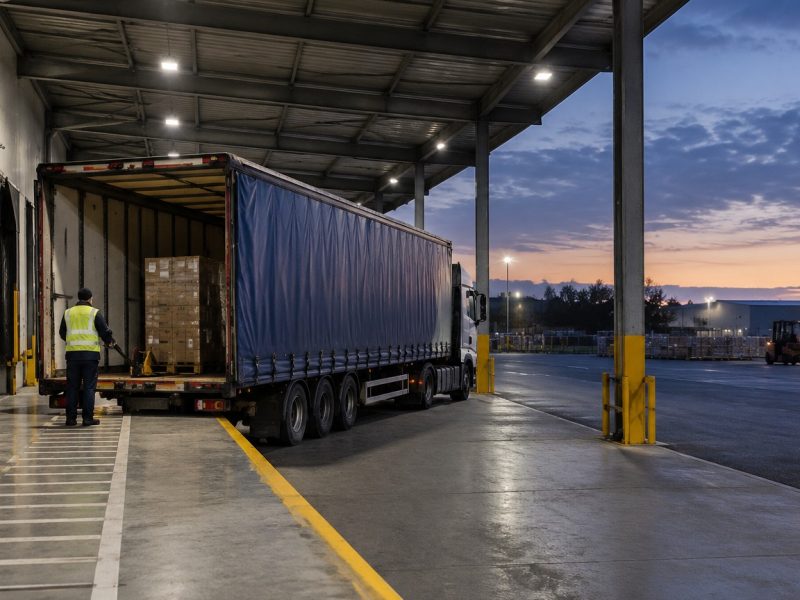
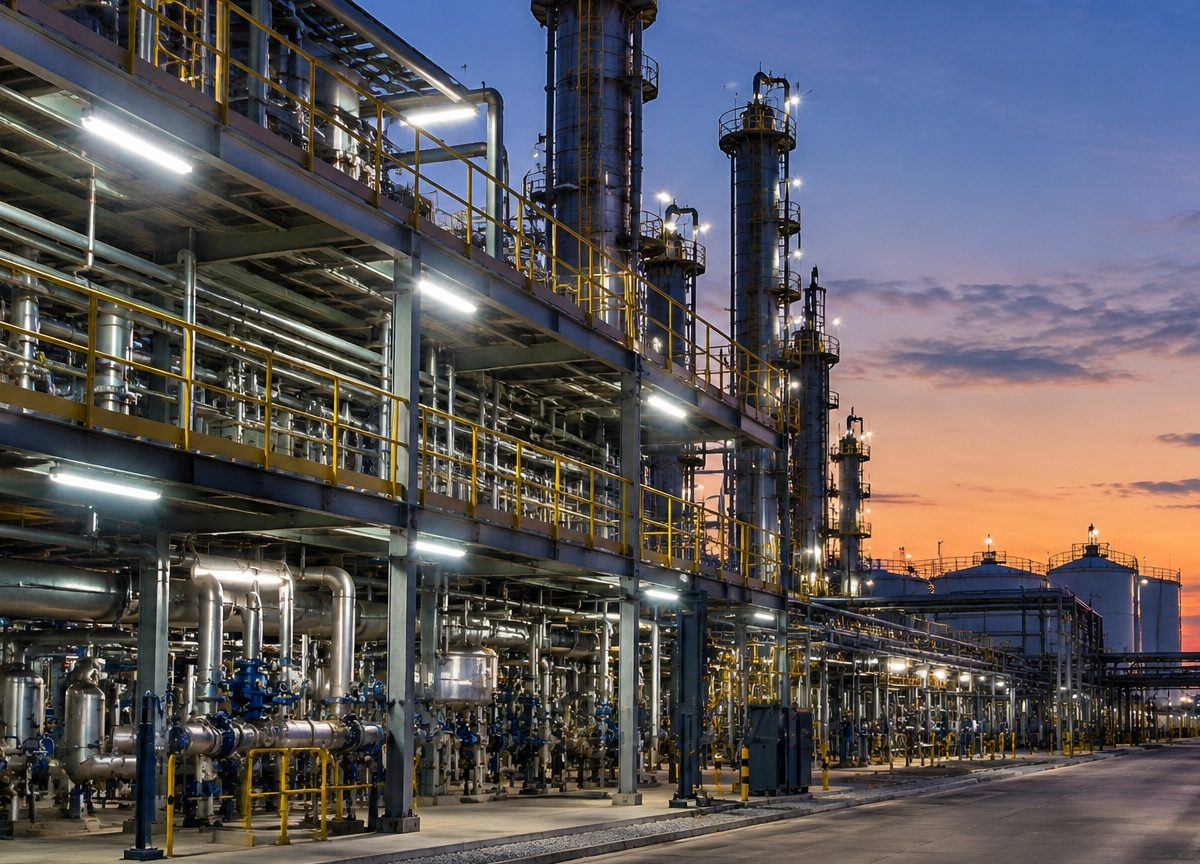
Specifying explosion proof lighting for chemical plants means matching equipment to defined locations and tasks. A chemical plant can contain process platforms, pump areas, loading positions, access routes, control spaces and locations with different environmental conditions. They should not all inherit one fixture specification simply because they belong to the same facility.
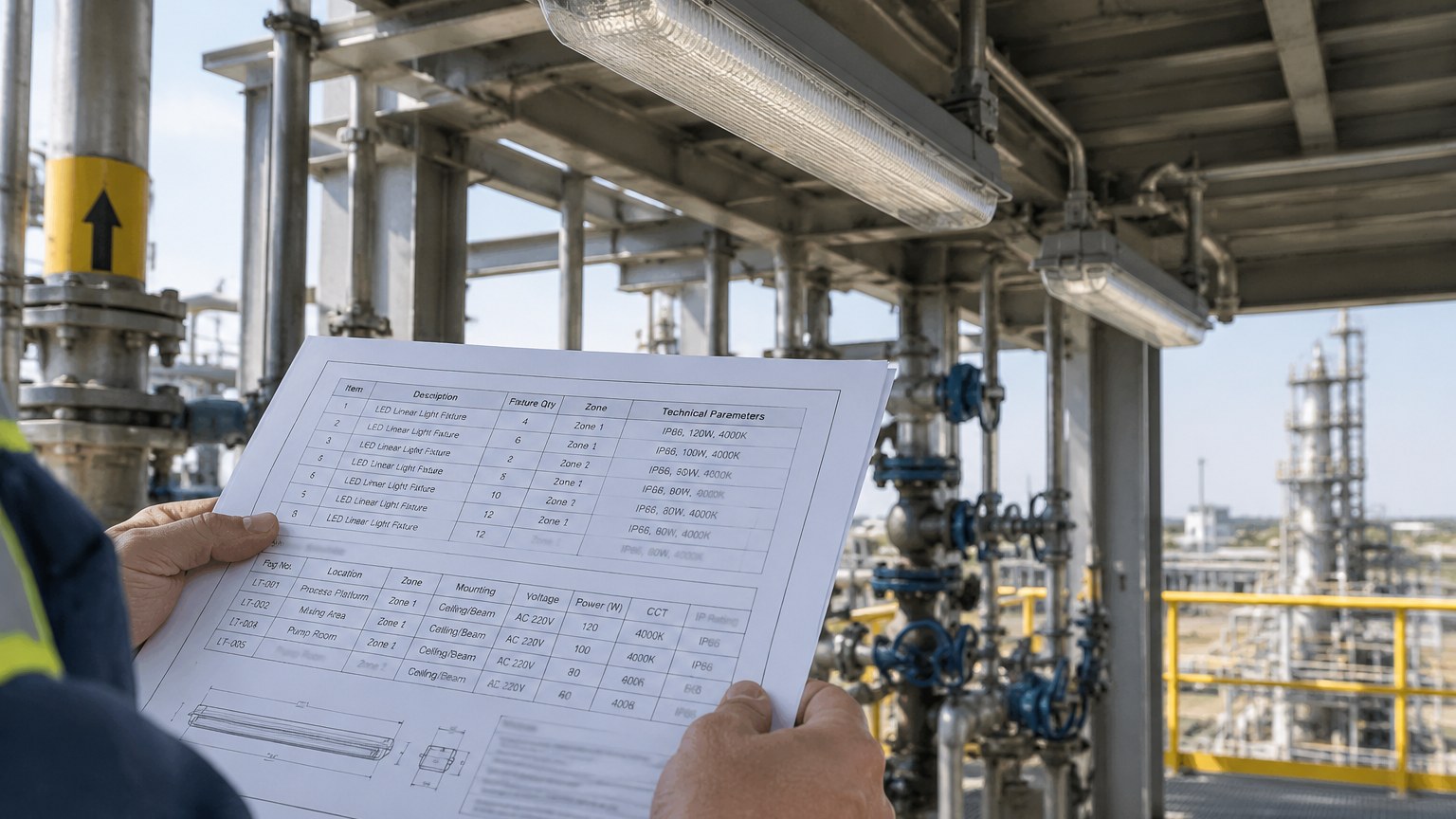
For a useful quotation, divide the project into identifiable areas, record the applicable hazardous-area information and establish what personnel must see in each area. Then compare the proposed equipment, lighting calculations, accessories and delivery scope against that brief.
Start with the plant’s area classification
Use the site’s documented area classification and applicable equipment-selection requirements. The HSE ATEX overview explains that classification depends on the likelihood and persistence of an explosive atmosphere. A purchasing team should not infer the classification from the word “chemical,” from a photograph or from a supplier’s application list.
Keep gas zones 0, 1 and 2 separate from dust zones 20, 21 and 22. A plant may involve gas, dust, both or non-hazardous locations. The HSE zoning guide describes the distinction and corresponding equipment selection.
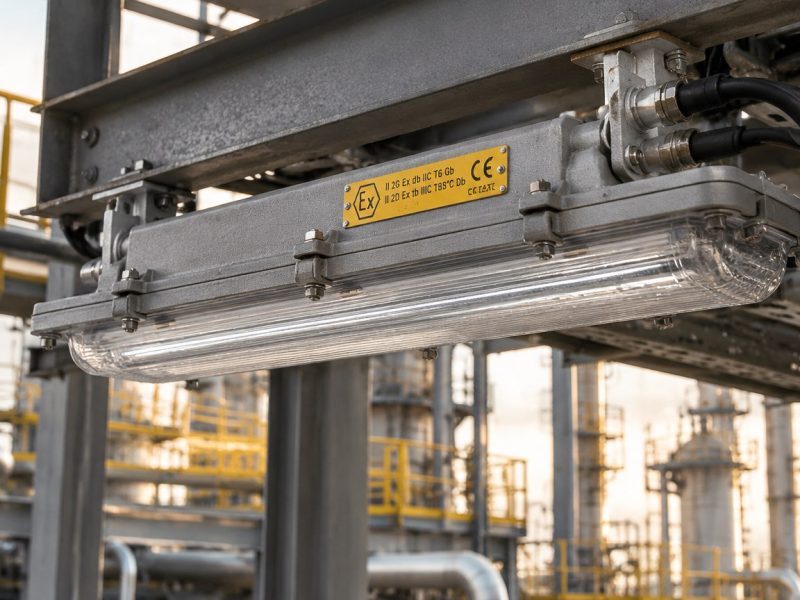
For each location, record the relevant substances, environmental limits and equipment requirements from the approved project information. Review the selected complete luminaire’s marking and conditions against those requirements. Our ATEX marking guide provides background for organising this review.
Divide the lighting schedule by task and access
A useful chemical plant lighting specification describes activities rather than listing wattages alone. A route used to move between process areas, a valve inspection point and a loading position may need different light distribution and mounting arrangements.
The following is an illustrative 96-fixture purchasing schedule, not a recommended design or a declaration of zone classification for these locations.
| Project area | Example quantity | Task to evaluate | Information needed for the offer |
|---|---|---|---|
| Process platforms | 32 | Movement around structures and equipment | Platform geometry, mounting positions, shadows and access |
| Pump and valve areas | 24 | Identification, inspection and routine operations | Task locations, obstructions and service conditions |
| Loading positions | 16 | Vehicle and pedestrian interaction | Approach routes, glare and visibility transitions |
| Access routes | 24 | Walking, steps and changes in direction | Route dimensions, mounting constraints and surrounding light |
| Total | 96 | Separate requirements remain identifiable | Four corresponding technical and commercial lines |
The HSE workplace-transport lighting guidance identifies plant, junctions, pedestrian routes and loading areas as locations deserving attention. On a chemical site, compare those visibility needs with the permitted equipment and installation arrangement.
Select light distribution before fixing the wattage
Specify the surfaces and activities to evaluate, then agree the lighting criteria and calculation assumptions with the project designer. Use the exact photometric data for the offered model. Pipes, columns, platforms and machinery can obstruct light even where a general open-floor calculation looks acceptable.
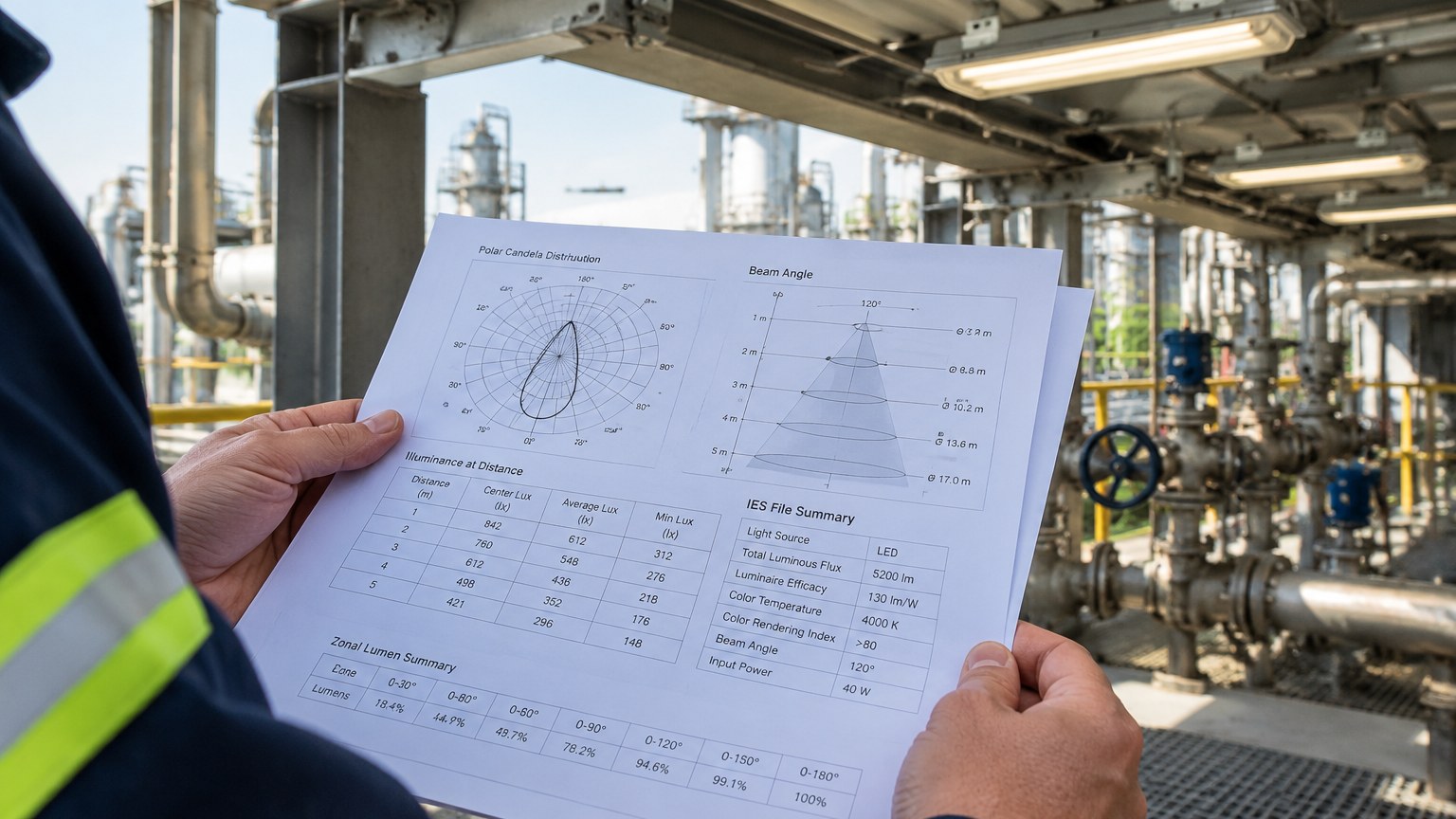
Different tasks may need local lighting in addition to general lighting. HSE’s human-factors lighting guidance uses a 300 lux control-room example to show why detailed diagram work may still need a local lamp. That example is not a universal illumination requirement for chemical plant areas.
This distinction helps avoid a common buying mistake: increasing the wattage of every fixture to solve one difficult inspection position. A better layout or an appropriate task-lighting arrangement may address the task more effectively, subject to the site’s equipment requirements.
Keep model-level performance separate from series data
A product family may include several power, optical or mounting variants. The quotation should identify the exact configuration and its matching input power, output, ambient range, supply and evidence. Do not combine the watts of one variant with the lumens of a different variant.
For a simple arithmetic check, 80W × 120 lm/W = 9,600 lm, while 240W × 120 lm/W = 28,800 lm. These are examples of the relationship between power and efficacy, not verified output claims for a supplied model. If a listing mixes those figures, resolve the model identification before using them in a lighting calculation.
| Configuration field | What should stay together | Purchasing consequence of a mismatch |
|---|---|---|
| Power and light output | Data for one exact variant and defined conditions | Incorrect comparison or lighting calculation |
| Optical distribution | Matching photometric file | Unsuitable coverage or glare assessment |
| Mounting and entries | Permitted arrangement for that model | Accessories or installation assumptions may be wrong |
| Hazardous-area evidence | Scope covering the offered configuration | Technical acceptance can remain unresolved |
Our ATEX lighting range can be used to start a product discussion. The final order should refer to a defined configuration rather than a broad family description.
Compare energy using each area’s operating schedule
One plant-wide annual-hours assumption may misrepresent the project. Some positions operate continuously, while others follow a shift or intermittent work schedule. Record the expected operating state for each area and compare options that satisfy the same requirements.
For illustration, assume all 96 fixtures in the purchasing schedule draw 80W, but operate on different annual schedules:
| Example group | Fixtures | Assumed annual hours | Calculated annual energy |
|---|---|---|---|
| Process platforms | 32 | 6,000 h | 15,360 kWh |
| Pump and valve areas | 24 | 6,000 h | 11,520 kWh |
| Loading positions | 16 | 3,000 h | 3,840 kWh |
| Access routes | 24 | 4,000 h | 7,680 kWh |
| Total | 96 | Different by area | 38,400 kWh |
At an illustrative rate of US$0.12/kWh, this is US$4,608 per year. The calculation uses quantity × watts ÷ 1,000 × hours. Replace these assumptions with the actual accepted fixtures and operating schedules; they are not a recommended plant design or a savings claim.
If controls are proposed, identify their permitted arrangement and the required behaviour for each area. Energy reduction should not come from assuming that lighting needed for a task or emergency function can simply be switched off.
Include corrosion, cleaning and maintenance in the RFQ
Describe the actual exposure: moisture, cleaning methods, chemicals, temperature conditions and the location’s maintenance access. An ingress-protection rating does not by itself establish resistance to every chemical or cleaning process.
For maintenance, identify how equipment is accessed, isolated, inspected and returned to service. HSE’s major-hazard maintenance guidance highlights the importance of planning and control around these activities. Compare documented service arrangements and spare support rather than relying only on an advertised lifetime.
Ask the chemical plant lighting supplier to separate fixture quantities from mounting sets, entry accessories, project supports and agreed spare items. For the 96-fixture example, one included mounting set per fixture would mean 96 sets; other accessories should follow the actual installation schedule, not an assumed universal ratio.
Frequently asked questions
Does every area in a chemical plant need the same ATEX light?
No. The site’s assessment, equipment requirements, task, environment and installation arrangement determine the selection. The facility’s industry name is not an area classification.
Can one product serve platforms and loading areas?
Possibly, if its complete ratings and photometric performance suit both arrangements. Keep the layouts and task requirements separate when evaluating that possibility.
Is 300 lux the required lighting level for a chemical plant?
No. The cited control-room example illustrates how task detail affects lighting needs. Establish appropriate criteria for the actual locations, tasks and applicable project requirements.
What makes a chemical plant lighting quotation easier to evaluate?
A location-based schedule, exact offered models, matching documentation and photometric data, defined accessories, commercial scope and delivery requirements. This lets purchasing compare offers without losing the engineering distinctions.
Send a location-based project enquiry
Send CoolShinePro your chemical plant lighting brief with the area information, layout, quantities and operating schedules. For a project already specified as Zone 2, our Zone 2 LED lighting RFQ guide adds a focused checklist. For certification-route questions, use our ATEX versus IECEx comparison.