
LED panel light wattage tells a buyer how much electrical power a fitting uses at a specified operating point. It does not, by itself, tell you which panel delivers more light, how many a room needs or whether the lighting will be comfortable.
For a commercial project, compare measured complete-luminaire output, power and distribution together. A 36W proposal can outperform a 40W proposal on light output, while a 48W proposal may reduce the required fitting count in another layout. This guide shows how to make those comparisons without treating all products at one wattage as equivalent.
Read watts, lumens and efficacy as three linked values
Watts describe input power; lumens describe light output. Luminaire efficacy is the measured delivered output divided by complete-fitting input, expressed in lm/W. The US Department of Energy’s commercial luminaire purchasing guidance uses that relationship and advises comparing like products.
Use the same tested configuration for all three values. A bare LED-chip efficacy, a family-level lumen range and a selected driver’s input power do not necessarily describe one assembled panel.
| Illustrative proposal | Complete-fitting input | Delivered lumen assumption | Calculated luminaire efficacy |
|---|---|---|---|
| A: efficient lower-power option | 36W | 4,320 lm | 120 lm/W |
| B: mid-power option | 40W | 4,200 lm | 105 lm/W |
| C: higher-output option | 48W | 4,800 lm | 100 lm/W |
These are calculation examples, not three confirmed CoolShinePro models. Proposal A uses 10% less power than B while delivering about 2.9% more lumens under these assumptions. Proposal C delivers the most lumens per fitting, but has the lowest efficacy in this particular comparison.
That does not make 48W panels inherently inefficient. A different 48W panel could have different measured output and distribution. Compare the actual reports, rather than extending this example into a ranking of all 36W, 40W and 48W products.
Check whether the specification sheet describes one operating point
A useful consistency check is 40W × 100 lm/W = 4,000 lm. If the offered configuration is instead documented at 4,800 lm and 40W, its calculated efficacy is 120 lm/W. Both combinations are possible, but they are different claims and should not be mixed on one order line.
Confirm whether the wattage is fixed, field-selectable or controlled. The selected CCT, driver and diffuser can affect output. For a configurable panel, obtain the performance data for the exact switch setting and optical version being purchased.

CoolShinePro’s 40W 600×600 panel product page provides a real starting point for a configuration-specific enquiry. Its source record includes AC100–240V, IP20 and Ra 80. It should not be used to infer that every 36W or 48W alternative has the same dimensions, control equipment or photometric performance.
This guide does not assign the illustrative output table to that product. The selected version’s matching test report and dimensional drawing should populate the final purchasing schedule.
Work out the room quantity before choosing by unit wattage
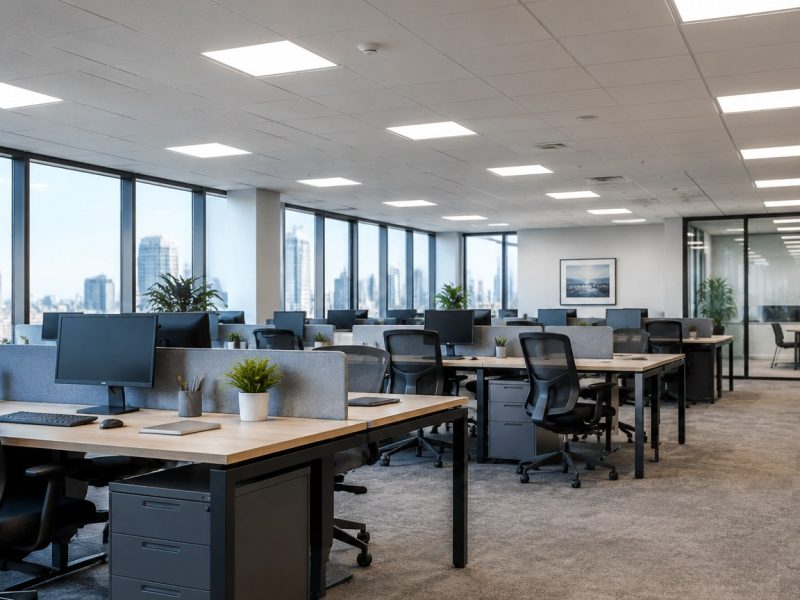
Consider a hypothetical 10 m × 8 m room, or 80 m², with an agreed 500-lux maintained average target, utilization factor 0.60 and maintenance factor 0.80. The target is a project assumption, not a requirement for every office, clinic or classroom.
Starting quantity = room area × target lux ÷ (delivered lumens per panel × utilization factor × maintenance factor).
Using the three illustrative proposals gives:
| Proposal | Calculated quantity before rounding | Starting quantity | Connected load | Estimated maintained average |
|---|---|---|---|---|
| A: 36W, 4,320 lm | 19.29 | 20 | 720W | 518.4 lux |
| B: 40W, 4,200 lm | 19.84 | 20 | 800W | 504 lux |
| C: 48W, 4,800 lm | 17.36 | 18 | 864W | 518.4 lux |
The 48W arrangement uses fewer panels but more total power than the 36W arrangement in this example. The 40W arrangement also uses more power than A while just meeting the chosen average target.
These are initial lumen-method estimates. The room geometry, ceiling height, furniture and each panel’s distribution can change the feasible layout. Do not remove two positions merely because the arithmetic rounds to 18 if the resulting arrangement creates poor uniformity or glare.
For a different brief of 300 lux in the same assumed room, proposal A’s quantity becomes 11.57, rounded to 12 panels. That contrast shows how strongly the task brief affects quantity. It is more useful than asking how many square metres a 40W panel “normally covers” without any design conditions.
Compare energy at the room level
At an illustrative 3,000 operating hours per year, the connected loads above produce different annual totals:
| Layout | Annual electricity | Annual cost at assumed $0.15/kWh |
|---|---|---|
| 20 × 36W | 2,160 kWh | $324 |
| 20 × 40W | 2,400 kWh | $360 |
| 18 × 48W | 2,592 kWh | $388.80 |
The difference between A and C is 432 kWh, or $64.80 per room per year under these assumptions. Across 10 identical rooms, that becomes 4,320 kWh and $648. Use the actual tariff, operating schedule and approved quantity in a project budget.
Controls should be assessed separately. A dimming command is not necessarily the same percentage reduction in electrical power. For example, a request for 50% light output should not automatically be entered as 50% input power without the selected driver’s performance data.
Define the interface, controller and operating behaviour before sample approval. Our dimmable-panel buying guide covers that purchasing question in more detail.
Keep glare, colour and visual comfort in the specification
A higher-wattage panel is not automatically more glaring, and a lower-wattage panel is not automatically comfortable. Source luminance, optical distribution, mounting positions and the room arrangement all contribute to the result.
If a project specifies a glare limit, assess it with the relevant room model and photometric data. A catalogue “UGR<19” description should not be treated as a guarantee for every arrangement. Ask the designer to evaluate the actual layout instead of accepting a wattage-based comfort claim.
Similarly, Ra 80 and Ra 90 describe different colour-rendering specifications, not different wattage categories. A colour-sensitive inspection or clinical task needs its own brief. Do not assume a panel is approved for every medical use because a product description mentions hospitals.
For a sample order, keep the requested CCT and colour-rendering configuration fixed across the comparison. Our office colour-temperature guide addresses the colour decision separately, so it does not have to be confused with electrical power selection.
Check size and driver access independently of power
Two 40W panels can have different body dimensions and installation methods. A 600×600-class product is not necessarily a 600 mm body, and a rectangular panel at the same wattage may need different ceiling supports and access space.
For a hypothetical opening of 600 × 600 mm, a selected 595 × 595 mm body leaves 5 mm of nominal total difference per axis, or 2.5 mm on each side if perfectly centred. That arithmetic does not establish that the ceiling grid, retaining system or fire requirements are suitable.
Confirm driver dimensions, connector access and the complete installed depth. Do not add an unapproved driver simply because the headline wattage matches. Use our panel-size guide and mounting-options guide for those separate checks.

Request a quote against the lighting result
Send the supplier the room drawings, target task-plane lighting, supply, ceiling arrangement and required controls. Ask for the exact order code, complete-fitting input, delivered lumens, photometry and a configuration-matched sample.
For the hypothetical 10-room example, compare 200 panels under A, 200 under B or 180 under C, subject to the approved layouts. Keep quantities and total connected load in the quotation rather than buying whichever unit has the smallest wattage or lowest price.
Contact CoolShinePro with those requirements to prepare a product-specific proposal. The useful comparison is the complete lighting system: its visual performance, power, installation and service requirements together.